Special Secret Santa Bundle

secretsantaI have a Secret Santa giveaway that I will be giving to one special member of Schoolin’ Swag on December 1. This will be lovely 3-book bundle from Dyslexia Games (The Thinking Tree)​ (“Coffee Time Journal, “A Day Like Tomorrow” and “How to Homeschool” purse sized guide!).

I’m not telling how I am deciding upon the winner. Let’s just say I’ll be watching for who’s naughty and who’s nice. 😀

Christmas Countdown!

We are counting down the days at Schoolin’ Swag! Our “12 Hours of Christmas” event begins at 9am on December 1, and in preparation for the festivities, we are giving away a prize a day in the group! Prizes already given away:

fatal-illusions2Today we are offering two paperback copies of “Fatal Illusions” by my author friend, Adam Blumer. This is a clean (no worries about language or suggestive content) Christian mystery, full of riveting suspense!  Go over to the group on Facebook and enter to win. Winners will be drawn at 10pm Mountain Time.

Upcoming Countdown Prizes:

Saturday: A copy of Rapid Recall Addition from Little Giant Steps! (value $45.54)

Sunday: From Memoria Press, we’ll have their set of 4 Advent books, as well as a Classical Christmas CD from their Lingua Angelica course! (total value $56.95)

Monday: A $15 Gift Certificate from Usborne Books!

Tuesday: “12 Hours of Christmas” event begins at 9am!

A Day in the Life: Rats, Snowy Poetry, Lazy Lasagna, Bloody Mary and the White Witch

I thought I’d take you through some snapshots of what our school day looks like. I remember as a new homeschooler, I was so curious about how everyone’s day was structured.

Our 4th grader is always up first, so we get her started with breakfast and chores. She had a little extra to take care of today, tidying the school book shelf in addition to the other things on her list. By 10am we were starting school. I’m an advocate of letting our kids sleep and getting the best hours out of them instead of yanking them out of bed at “dark thirty” and having a counterproductive educational experience. Here is what Katie’s day mapped out to be:

  • Keys for Kids (she listens to the daily broadcast, does the key verse for her cursive practice along with her signature, and we discuss the lesson).
  • This year is reading-intensive, as you’ll see. This is deliberate, because my sciency gal struggles in writing and spelling. First, she read a chapter from Hero Tales (we are now learning about Dwight Moody…in the last lesson, the Chicago fire was mentioned so we looked up some info on that).
  • Read aloud time. We are reading a chapter or two from “Mrs. Frisby and the Rats of NIMH”. She sketches a scene from the story. Next we will begin “The Curious World of Calpurnia Tate” (a book about a sciency girl, back in the 1800’s–our public library has it as well as the sequel!).
  • Wiggle break (Katie dances around to get some nervous energy out…her choices were “The Syncopated Clock” and “Sleigh Ride” which goes along with her current poetry project).
  • She reads her “for fun” reading. Right now it is “The Little Lemons Detective Agency: The Case of the Missing Suspect” (which I got free for Kindle).
  • We are working on memorizing and reciting “Stopping By Woods on a Snowy Evening” by Robert Frost.
  • She has a spelling list to practice, using Spelling City. Her reading curriculum with Christian Light has a list of words which corresponds with each story in her reader, so I just plug that in so she can review word meanings and practice spelling with games and exercises.
  • Today’s lesson for math is on fractions. She’s been doing well with this curriculum…today we cover 10ths and 100ths at CTC math. katectc
  • Today we are taking a break from our regular science (we alternate science and history, every other day), which is a study of plants, their structure and uses from Christian Light. We found a Venus fly trap and a grafted cactus to add some fun to that study last Friday. Today I came across this neat experiment in my web wanderings, looking for goodies to post at Schoolin’ Swag. I happened to have all the things needed for it, so it’s a go! That rounds out our day.

Meanwhile, I am slogging through the laundry that I forgot on Saturday (yep, it happens!), and throwing together the layers for Lazy Crock Pot lasagna for supper.

Our 10th grader has fewer subjects, but does them more intensely. After waking up and getting chores squared away, he checks into Homeschool Planet to see his daily assignments.

mphplantoday

  • His Bible time right now until the end of the semester is brief daily readings from scripture at Bible Gateway. Then he journals what the verses mean for him personally. We just completed a series of videos and resources on creationism and apologetics, so I wanted to switch gears back to personal application.
  • We are using Teaching Textbooks for his algebra curriculum. This includes an interactive video and  practice problems. He can also read the transcript of the lesson if he needs to. In the workbook are review questions.
  • We recently decided to do a modified block style of lesson plan for Michael, which means that his core subjects of Physical Science, World History, Language Arts/Grammar, and Literature/Writing each have one day assigned to them. On that day, we do a more intensive lesson, usually containing double lessons. Today he is answering 15 review questions from his chapter in Story of the World on Mary, Queen of Scots. Then he is viewing a video about her from the History Channel.
  • Finally, he will do some practical application of what he has been learning about greetings and introductions in Spanish class. He will do an interactive exercise at this website, and then write his own dialogue between two friends, using the vocabulary he has learned thus far.
  • For his reading block, Michael has been going through “The Lion, the aslanwitchWitch, and the Wardrobe” by C. S. Lewis. Tomorrow, his literature/writing day, he will read Chapters 13 and 14, and then write out what he believes the “secret conversation” between Aslan and the White Witch may have been like.

My other activities during the day include reviewing these materials which I just received from The Learning Tree (exciting stuff!), and gathering up the last of the donations for the “12 Hours of Christmas” event coming up on December 1st at Schoolin’ Swag. Today I got donations from the Anne of Green Gables page on Facebook and Plant Therapy …still waiting to hear from Apologia. Exciting times!

For the Love of Learning,
Diane

“Learn With Homer” Review and Deep Discount!

Have you met Homer yet? Learn With Homer was born (well, it became public) in August of 2013. In the short time that has elapsed since then, this adorable pigeon and all of his buddies have gained quite a following…over 1 million children now learn with him! So what has all these prominent media, news, and educational sites buzzing? Stick with me, and find out!

What is Learn with Homer? Here is an infographic to help you understand the method:

homermethod

Learn With Homer accomplishes these four steps through beautiful, colorful graphics, gorgeous photography, engaging stories (a variety of history, myths, fables, folk tales, nursery rhymes), songs (from all around the world…and the vocabulary is linked to the lessons!), art, poetry, and games. There is so much to love about this site/app! This is not merely a reading program. It has such a wide scope of learning, including history, science, poetry, music and so much more (and they add new updates frequently)! Here is a screen shot to give you a sampling of the compelling beauty of the lessons:

homercolor

Just seeing images like these made ME want to play! Our art-loving daughter has totally fallen in love with this site. Even though the site gives suggested ages as 3-8, our 9-year-old has enjoyed it SO much! I logged her in and gave her the freedom to poke around on her own. She played for over 2 hours (there is no fluff…it is all lovely education presented in such a way that children love to learn), took a break, and went back for another hour. I wanted to see if it would really draw her in, or if I would have to “sell” its virtues to her. In no time at all, I heard her singing along with songs. She repeatedly came to me to share something she learned, or to tell me the plot of a new story. I didn’t even get a chance to try out my sales pitch! First thing this morning, she wanted to get back on.

katiehomer
She loves the drawing and art options, and the fact that she can get new “thinking caps” for her little kitty avatar.

Currently, Learn With Homer is offered for pc (web version) and iPad. The iPad version got a spectacular facelift just today! The new version includes little adorable Wickles who play in Pickle Wickle Park. Guess what they like to snack on? Now there are even more fun features to enjoy!

picklewicklepark

The web version is slated for update very soon, and there is an Android version in the works as well. If that’s not enough, an iPhone version will come out after the first of the year!

Need stats? Here you go! There are 22 levels for learning with Homer currently…including over 1,000 lessons and activities! The program is proven to boost reading scores by over 74%!

In a recent study conducted by the former US Assistant Secretary of Education, students who used Homer for 15 minutes a day over a 6-week period nearly doubled their scores on the TOPEL (Test of Preschool Early Literacy), a leading predictor of future reading and academic success.

homerstates

Are you dying to try it? No wonder!  Click here to sign up for a free 30-day trial! You can also get 50% off an annual subscription to Homer! Click here! The special discount code is already plugged in for you! Can it get any easier?

Disclaimer: I was given a year’s free subscription for Learn With Homer in exchange for an honest and objective review. 

“12 Hours of Christmas” Giveaway Coming up December 1!

12hoursxmasOur 2nd Annual “12 Hours Of Christmas” Giveaway on our Facebook group page is coming up December 1, from 9am until 9pm (Mountain Time)! If you are one of our (currently) 4,421 members, you are invited! This is a high energy, much-anticipated event. I try to plug in all my giveaway sleuthing savvy for this. 😉

Want to have a sneak peek at some of the prizes that will be offered (and, as always, you need only to comment on the postings you like in order to enter…I don’t make my people jump through a bunch of hoops)? I’ve got a nice mix of some homeschool-y stuff and some fun-and-pampering stuff. 🙂 Here is what I have thus far:

Hopefully, I have a few more items coming, but this is already shaping up to be a great event! Come on over and join Schoolin’ Swag to enter for these goodies. Don’t forget to mark your calendars!

“The Thinking Tree” Giveaway Winner!

I’m delighted to announce the winner of our big giveaway from The Thinking Tree! The winner will receive all of this:

The Boy’s Journal (value $32.00)

The Girl’s Journal (value $32.00)

The Spelling Journal (value $24.50)

The Handbook for Moms (value 32.50)

And the winner is… Deborah Freeman!

Congratulations, Deborah! I will need you to email your shipping address to me, ASAP! You may use the contact box below (just put your address in the the “comment” portion), and the information will be sent directly to me. How spiffy is that? 😉

← Back

Thank you for your response. ✨


Keep an eye out here at The Schoolin’ Swag Blog for more great giveaways!

Dyslexia At Our House (Plus Freebies and HUGE Giveaway Bundle from The Thinking Tree–value over $100!))

I noticed our son had some reading challenges early on. Not only that, but letter writing challenges, number challenges, math challenges, and handwriting challenges. This was prior to putting him in our state’s virtual academy for homeschool. We only remained with K12 for a year and a half, but in that time, testing was done (along with reams of IEPs and tons of online meetings which were very frustrating, to be honest). Dyslexia. Not profound, but significant.

When I pulled our kids from K12, I had to maintain my own course and establish strategies that would work for our son to succeed. Here are some of the things I found helpful:

  • I used a basic evaluation like this to discern if I was headed in the right direction prior to formal testing.
  • One of the best discoveries I made as a mom was realizing it helped our son a great deal to separate his math from any reading assignments. Do math first. Do math after recess or lunch. Why? Because in reading, his brain is going top-to-bottom and left-to-right on the page. Then in math he had times when his brain was required to perform processes going from right-to left, and bottom-from-top. A simple truth, but one I’d never considered before. His brain was exhausted. This is what it may have looked like to him during a normal school day: http://space.io9.com/nasa-tossed-astronauts-with-this-gimbal-rig-before-laun-1727900059
  • We started slow with reading, and I found that the Abeka pages I reverted to (because I had them on hand) were way, WAY too busy for him. There was too much color, too many different concepts on his math pages in particular. So at that point, I switched to Rod and Staff , which was very basic, one concept at a time, and no bells and whistles to distract. Now that he is older, we use Teaching Textbooks, which is simple, quiet lecture, easy to follow, and appeals to visual, auditory, and kinesthetic learners.
  • For reading, I found for our son that he had the best success when he read books in comic book form, with text bubbles. There was something about having small bits of text, isolated and not in paragraph form, that really helped him. “Missile Mouse” (we bought the whole set for Christmas) was a favorite, and we had a wide variety of these books at our library.
  • I used Abeka Phonics for all three of our kids, with good success. It uses some rote drill along with pictures, and that helped our son to associate sounds with images in his mind.
  • I also found that in the beginning he made good progress writing in text bubbles as well! We made our own story boards, but here is a fun, free template source.
  • Simple exercises like these can help exercise the mind!
  • For reading comprehension, I found it very helpful at the start for our son to use sticky notes for each paragraph. We would decide what the “big idea” in that paragraph was, and write it on the note. This trained his mind to look not only for main ideas and subjects of sentences, but also for how everything works in context.
  • Using a bookmark under lines of text while reading helped a lot. Pointing at each word with his finger did not help him to train his mind to see groups of words together. Using a straight edge under each line of text helped his eyes to embrace ideas instead of just syllables.
  • Something that is a relatively new idea is the dyslexia font, available free here. It can be used to create your own printables and worksheets. This was not around when we were first testing the waters, but I’m happy to offer it now!
  • While we spent time on handwriting (of course), I didn’t make a federal case out of it, and for our purposes we only focused on cursive for his signature.
  • One of the most liberating things we did was teach typing/keyboarding early. Not only is this a skill our kids must have in this generation and beyond, but for our son, it skipped the whole mental gymnastic thing with the letters he commonly “flipped”. Because he learned the keyboard by rote, his brain told him “b” and he typed “b”. Incorporating the keyboard into our homeschooling was a total game-changer for us! You can find good, free typing programs here.
  • Our son reads well now (but still prefers not to read aloud). He enjoys works with more difficult vocabulary and mythical names, etc. like the Narnia series, the Chronicles of Prydain, and the popular Tolkien books. I’m so grateful for his progress.
  • Even now, when we have a good handle on reading, I still see the challenges show up again in math. He can do mental math very quickly, but on paper, it’s a chore. For instance, in multiplication review, using numbers in hundreds and thousands, and remembering to bump numbers one spot to the left in the answers…the frustrations came up again. Understanding fully the “why” of doing it helps some, and TT does a great job at that. But I remembered again that he cannot do reading in close proximity to math. I’d forgotten, and set him up for a very bad day with algebra.

I hope these tips might help someone else who is struggling on this journey. In the last year, I discovered The Thinking Tree–a resource I would have given my right arm for years ago! Go and check them out!

Meanwhile, I have a HUGE giveaway for you from The Thinking Tree! Comment below to enter (and be sure to “follow” this blog!). I’ll post the name of the winner on Friday, 10 am (Mountain Time). Here’s what you are entering to win:

The Boy’s Journal (value $32.00)

The Girl’s Journal (value $32.00)

The Spelling Journal (value $24.50)

The Handbook for Moms (value 32.50)

The Benefit of Using Free Materials (with FREEBIES, of course!)

freestuffObviously, the crowning benefit of using free stuff is…it’s FREE! Right? No rocket science there.  But let’s think further.

How much money have you wasted because you read/heard recommendations about some fabulous (and perhaps spendy) product, bought it, tried it, shelved it? Me too. Something we need to remember is that each of our kids is pretty intricately designed. Buying what Ursula Unschooler or Becky Abeka did because it worked so fabulously for them might not be the best use of your precious homeschooling funds.  One HUGE benefit of using free materials is that if you don’t like it, there is no guilt in kicking it to the curb.

Another benefit of utilizing free resources is that (unless you are unusually blessed) your kids will probably each need a different approach to their schooling. You may have one child who is not academically wired at all and requires quite a bit of coaxing along. The next child may be bright, but struggling with a learning disability which requires you to rethink e-v-e-r-y-t-h-i-n-g. Yet another child may thrive on using workbooks, and functions exceptionally well independently. Another may be a move-and-touch learner…NO WAY workbooks will work. Have you felt this dilemma? In a perfect world, we could buy one box curriculum, and it would be seamlessly one-size-fits-all. But this is not a perfect world, and our kids are wired with amazing and wonderful diversity. Using free materials can help us adapt from one child to the next. It may enable us to tweak an existing curriculum so that it is usable between child #1 and child #3, by adding more audio appeal, more visual appeal, more touch appeal, more interest-led appeal.

Quite frankly, using free materials may make our break our ability to homeschool in the first place! These days, and with our current economy situation, it can be harder and harder to homeschool. The paycheck doesn’t stretch as far as it used to, and you may need one parent to be stay-at-home in order to make everything work. (If you have both parents in the home working while homeschooling, check out this blog post for some good coping strategies.)

In our home, I stay home with the kids. But that means we do a lot of penny pinching. We shop sales. We visit Dollar Tree routinely. Lots of our clothes come from second hand and consignment shops. We don’t do a whole lot of eating out or activities which require financing.

When I really launched our homeschool journey, I was stuck between a rock and a hard spot. I knew we had to quit what we were doing (public school virtual academy, where everything was provided free), but I did not have the funding to buy curriculum, and I needed something NOW. We withdrew our kids from the academy mid-Spring semester, Not ideal from a planning standpoint. How did we survive? Free curricula and internet.  And the library became a very regular stop for us each week.

In previous years, we had various curricula given to us or purchased for us. We did Bob Jones dvds, Abeka dvds, and Rod and Staff because of gracious gifts and provisions. They were not only pricey–they were also not “us”. I had not found our niche yet. So, I scrambled. I gave our kids a couple weeks to “deschoolify” (we did reading and basic math I scraped together in a flurry) and used that time to pour hours and hours into scouring the internet for quality, free resources. That was back in 2007.

Things have really stepped up since then. As homeschooling becomes more widely accepted, the internet has exploded with great stuff to use! Amazing, worthwhile stuff.  Back in 2007, things were not so plentiful. It’s amazing the difference only a few years can make!

The lifesaving freebies for me in our transition time were:

  • http://allinonehomeschool.com/ This was by far my biggest salvation. It is Christian (which is my preference), and structured, with lots of printables and live links included. It is now available through high school. This website alone gave me the format I needed to move forward even while I kept searching for ideal stuff that would be tailored to our family. It covers the core subjects and also electives. Flexible and free, you can do it at your own pace.
  • http://keysforkids.org I used this site as additional Bible material. It is free and gives some practical application for basic Bible truths through stories kids can relate to.
  • https://www.amblesideonline.org/ When I needed more material to beef up what we were doing, I started looking into the Charlotte Mason method to see if it would jive with my kids and their learning styles. In the end, it was a bit suicidal for me because it required a lot of hunting down of resources, scouring the web again, and finding out of print books. My health was not good at the time, so this was all pretty overwhelming for me. God was so gracious, and when I went to the used bookstore in our little western town, I found several old volumes that I needed. The likelihood of that happening is pretty slim. I’m grateful He was looking out for me!
  • At this link you’ll find the Schoolin’ Swag Pinterest board for complete curricula (and there’s a LOT more there, too). Not all of the pins are for free stuff, but many of them are!
  • I highly recommend following this site and this one as well, for lots of high quality freebies!

As a result of my scrambling, Schoolin’ Swag was born. It has now become a favorite resource to nearly 4,500 homeschoolers and continues to grow on a daily basis. Daily, we have dozens of freebies, discounts and deals posted. Of course, I highly recommend joining there as well!

For the Love of Learning,
Diane

What “Bible Time” Looks Like For Us (and LOTS of freebies)

From early on, I start teaching our kids to read their Bibles independently. I want them to see that God can speak to them, and they can understand it. Too much spoon-feeding helps our kids to feel they need to be reliant upon us in order to have a walk with God.

So, from the time they are small, we listen to Keys for Kids every day (you can also get it free in booklet form). We talk about the main idea of each broadcast. I copy and paste the verse for the day into a free handwriting worksheet maker for daily copy work.

When the kids were tiny, we used these little flashcards to learn a verse by heart for every letter of the alphabet.

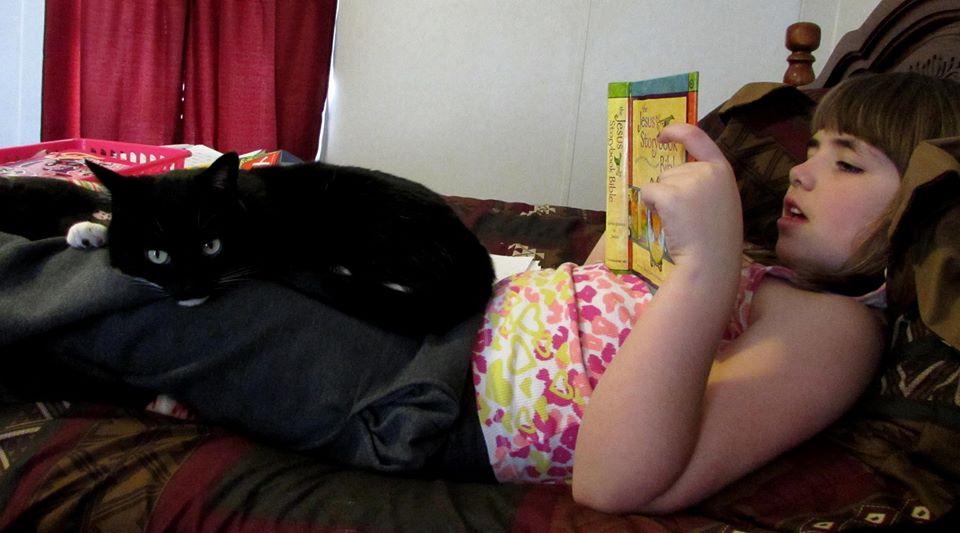
I’ve also used a children’s Bible like this one, so they can begin reading passages on their own.

Who needs to hear the Bible read aloud more than the cat?

In addition, I also love this brand new children’s topical Bible, compiled by my friend, Michelle Brock.

I’ve used free printable Bible curricula like this and this (for older children).

I also enjoy including missionary biographies. Currently we are using this book, and we are really enjoying it. I’ve tried to encourage our youngest to write a little biography of her own using this free printable.

For my high schoolers, I’ve done some different things. I’ve used the New Answers Book (from Answers in Genesis), which is available free online (as well as a free study guide) for apologetics/creation science.  I’ve used this free material to create a “Life of Christ” course (here is a free commentary also). I put together a Biblical Counseling course using the free resources at Debi Pryde’s site in conjunction with this book by Elyse Fitzpatrick.

Finally, I’ve found plenty of videos recently addressing the idea of why the Bible is trustworthy. Here are the videos my 10th grader has watched thus far:

Science Confirms the Bible is True Part 1

Science Confirms the Bible is True Part 2

How Do We Know the Bible is True? (Josh McDowell)

40 Archaeology Facts Which Prove the Bible is True

A little more advanced is this series, “From the Mind of God to the Mind of Man” (free mp3s) by Mark Minnick, which addresses questions about inspiration, translations, and why the Bible we have is reliable.

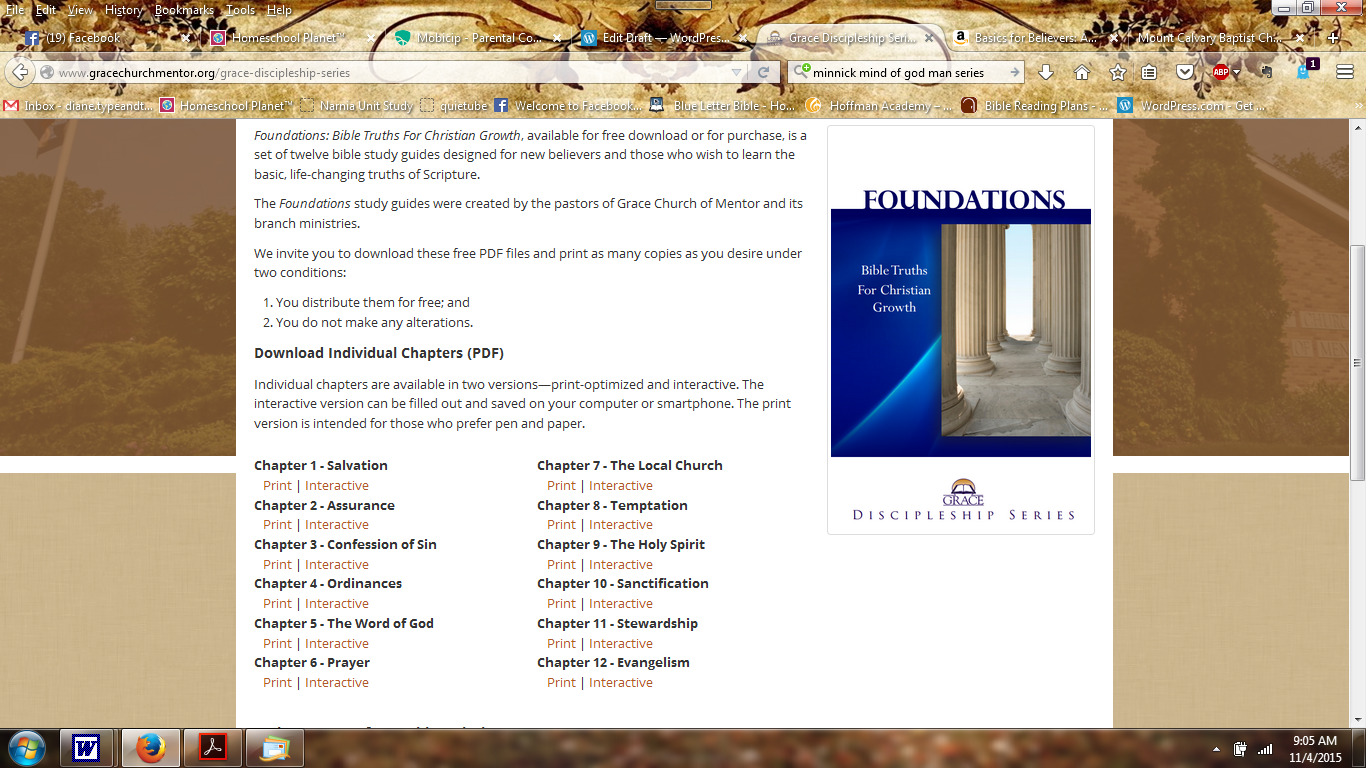
A great initial discipleship tool is “Basics for Believers” by Dr. Jim Berg (not free, but very reasonable). A more fully developed, free discipleship series called Foundations can be found here.

Here is a screen shot of all the topics covered:

foundationsHope this helps!

For the Love of Learning,
Diane

Curriculaholics Anonymous–Are You Addicted to Collecting and Perusing Stuff?

curriculahelpI’m a purger, not a piler. Piles make me crazy, and nothing distracts me more. True confession? Schoolin’ Swag was begun partly because I came across a ton of great homeschooling stuff I knew I’d never use, or I didn’t need at the moment…and I could not stand to let go of it! So I created the group as a place to park stuff (and in the process hopefully bless someone else who needed exactly that stuff). But that didn’t solve my compulsion to grab all things free and homeschool-oriented.

With all that free stuff at my fingertips, it was very easy to feel overwhelmed. Then it stopped being a blessing and turned into a very distracting burden. Counterproductive. I needed a “sieve” of questions to help me decide what was best. I have met people who buy stuff because it is on sale…without any particular goal or plan in mind. There may not even be a need for it. They may have never used that item before…but it was on SALE! Can you guess what the house looks like? Ever seen “Hoarders”? We don’t want to be that. We want to be good stewards of the money, time, and space we have…not to mention those few brain cells we have remaining.

So here’s the 5-question sieve for printables and downloads:

  1. Does this material jive with our learning style or can it be easily tweaked?
  2. Is this material going to necessitate additional purchases (supplies, etc) for it to be useful? Am I able/willing to invest in those?
  3. Does this fit in my lesson plan currently? Do I have a place to put it so I can readily find and plug it in?
  4. If this is something to save for the future, do I have a logical, usable, accessible way of storing it?
  5. Does grabbing this material obligate me to sign up for things I don’t want (read the fine print)?

At Schoolin’ Swag, I added a little sanity to my life by beginning some Files tabs. Also, by posting items in the group with a little blurb like “great resource for algebra” I can easily find it again, simply using the search tool with key terms. What else do I do with my stuff?  Here are some things I’ve found helpful.

  • First, I think it is good to ask why. Why do I think I need to do something different? Is it because what I am currently doing is not working? How do I believe this new thing will help me accomplish my goals? Don’t change for the sake of changing. Be purposeful.
  • I rarely bookmark anymore. It doesn’t really organize things in a usable manner for me, and it is too TOO easy to click to bookmark every little thing that seems appealing for that “rainy day”.
  • Pinterest? I’m personally not a fan. Many at Swag really love to use it, so I started Pinterest boards for our group. To me, that venue is totally sensory overload and it can be a certifiable time waster for me. I click one thing, which leads down the path to something else like a winding path through a dark forest. I get lost. I start out looking for lapbooks on George Washington and end up watching videos of dolphin rescues. Educational? Maybe. Productive? Not really.
  • I use Evernote (free) which allows me to do save pages (or portions or articles) in folders I can create in a way that makes sense to me. Just download the little toolbar button, and simply click the little elephant when you are on a page with something save-able. Here is a screen shot with the options at upper right for how you want to save and where. I create folders like “Michael’s School” (for things I know we’ll use this year) and “2016-2017 School Year” (for something I’m looking to use in the future). Subfolders can be set up for particular subjects and projects. That way things are not saved just as arbitrary bookmarks, but are categorized in a way so that I can FIND them!

evernotescreen

  • So I don’t “print and forget” those great freebies that are time sensitive and won’t be free later, I have plastic milk crates with hanging folders to organize things I’ve printed. Since they are open and available, the likelihood of my actually filing things is much greater. Just make folders for each grade/subject, paperclip your projects, and plunk ’em in. Go through the folders at least every 6 months. Pull stuff you have realized has lost its appeal and see if you can find a new home for it. If not, flip the paper over, and you have scrap for sketching, math problems, etc. I keep a box of scrap. 🙂
  • As far as free samples, I find I rarely use them unless they are substantial or it is a handout I need very SOON. So, I usually don’t bother with these and it uncomplicates my life.
  • Books? I’ve been guilty of grabbing some off the free cart at the library just because they looked cool. We flipped through it once, and off it went to Goodwill. Why add that stress? Check it out from the library if it is cool to look through but not something you’ll make good use of. If you have books that are just gathering dust, set them free! Sell them on Ebay, Varagesale, or even via Amazon buy back. Or, if you are feeling philanthropic, you can give them away on Facebook pages like this.
  • What about YouTube videos? We love to use those for school! Here is how to create playlists of your very own!
  • And how about those humongous downloads you grabbed? Those things that are 200, 300, 700 pages? Yikes!  Here is what I’ve done with those, because I keep forgetting I have them!  I started pulling up the cover page on my laptop, taking a screen shot (on my computer, I click the “prt sc” button at top right, then open Paint and click “paste” and then save the image).  Then I save the images to a folder I called “Homeschool Downloads”. At a glance, I can see what they are, and what they are called if I want to open them.

Got some great organization tips for curricula? A 12-step program? Tell us in the comments! 🙂

For the Love of Learning,

Diane