While it feels like June was just a few days ago, somehow we have passed Labor Day and started our school year. We had a wonderful but busy summer. Because of some spring traveling, we went later into the summer with our school year while also balancing summer activities.
Summer Fun
We did summer camp with out church, activities with 4-H and our American Heritage Girls and Trail Life troops. We spent several weeks at the river with family, tubing, fishing, swimming, and visiting. We grew our biggest garden to date, and even had enough extra to can tomatoes and pickles. There were a few lazy days spent enjoying our little above ground pool and lots of popsicles. We finished out our summer with a quick trip to Pennsylvania to visit friends and help out with a benefit auction. (I will be sharing more about that trip soon.)
Fall Fun Ideas
The calendar and the thermometer may say that fall is not here yet, but in my house we are calling it fall. Once Labor Day is over and our school year has begun I consider it fall. We are decorating for fall this weekend.
In some ways I was sad to see the flexibility of summer leave, but in many ways I am grateful for fall. We enjoyed the break but we all needed a return to our regular routines.
I am not much for pumpkin spice, but I love all things pumpkin and apple. And as soon as the weather starts to cool we will enjoy chili and soups. Soon the pumpkin patches will open and hopefully we can even enjoy a corn maze.
We are excited about field trips, the state fair (which we missed last year), turkey shows, and lots of camping. I am setting out our favorite fall books for the children to explore. It is a new season with new reasons to celebrate!
If you are excited about fall and looking for some fun ways to incorporate it into your homeschool, check out some of the great resources below. I would love to hear from you what you enjoyed this summer or what you are looking forward to this fall.
When you sign up for the Schoolin’ Swag free resource library you will get a link and password to the library, we are adding to the library each month with new items. You will also get a bi-weekly newsletter email to keep you up to date on what we have going on.
This post may contain affiliate or referral links, including Amazon affiliate links. As always I will never recommend a product that I don’t believe in and you will never be charged more for purchasing through our links. It does help pay for the costs associated with the blog.
*This post contains affiliate links, see disclosure below*
I love reading books, finding wonderful books for my children, and sharing new books with my readers. In today’s world, books share many messages, and it can sometimes be hard to know which books to buy for your children. If you are like me, you want books that are fun and interesting. More importantly, you want books that share your Christian worldview.
I am excited to share a new series that is both informative and enjoyable. Not only does it share my Christian worldview, it even teaches children about protestant church history.
You may remember the name, Danika Cooley, from my recent review of “Help Your Kids Learn and Love the Bible.” Well, Danika has come out with a new series titled the “Who, What, Why Series”. It has blessed me to read and review the first three books in that series and I am excited to share them with both my children and my readers.
Who What Why Series
This series comprises brief chapter books geared towards students that are eight to eleven years old. The books are informative but engaging and sometimes humorous. I think that younger students could enjoy them and learn from them through a family read-aloud.
In addition, older students would find them to be very simple but still educational. I will read them aloud, focusing on my children from ages seven to fifteen, but the three-year-old will also listen while he plays.
Each book contains illustrations that help the reader understand the book (and are often quite humorous), a timeline of events, and a works cited section so that you know where she derived the historical information.
Who Was Martin Luther?
Many children know a bit of basic information about Martin Luther. They may know him as the man that nailed something to the church doors, or the one that fought with the Catholic Church. However, this book goes into so much more of his rich and interesting history.
It starts with Martin’s childhood, discusses how he became a priest, why he stood up against the Catholic Church, the political turmoil of the time, his wife, and so much more.
I think my favorite quote from this book was, “God’s truth never stays hidden for long. It’s a truth worth staking our lives upon, worth fighting for, and worth studying daily.”
I love that along side teaching the history of Martin Luther, this book is sharing important truths about God and his word. Through reading, children can understand the importance of the work of Martin Luther and the many men who worked alongside him and after him so that we could know and understand the saving Gospel of Jesus Christ today.
What Was the Gutenberg Bible?
In today’s world, it is hard to understand not having readily available access to a Bible, but that has not always been the case. Today, I have over a dozen print Bibles in my home in several translations.
I regularly use an app on my phone that allows me to access the Bible in a tremendous number of translations, highlight verses, share scripture with others that use that app, and more. People hand out free Bibles at our state fair. We find them in most hotel rooms, and they are easily accessible by anyone in America that wants one. Today the Bible is translated into over 700 languages (more if you just include the New Testament).
Before the Gutenberg Bible, this was not the case. Most people did not have access to a Bible of their own or even a Bible in their language. This book shares about the Gutenberg Bible in a way that helps students understand the importance of this advancement.
In addition to learning about Gutenberg and his printing press, “What Was the Gutenberg Bible?” delves into who originally wrote the books of the Bible, the works of Wycliffe to translate the Bible, and so much more about the history of the Bible and how God has used it to share his word with people around the world.
Why Did the Reformation Happen?
Many Christians only have a basic idea or understanding of the Reformation. They might tell you it is when the protestant churches split from the Roman Catholic Church. They may know that involved Martin Luther, but often they cannot tell you about the other men involved or the many reasons for the split.
“Why Did the Reformation Happen?” explains the problems in the church at the time of the Reformation and Martin Luther’s role in the reformation. Additionally, it explains the changes that were made, the Five Solas, many church reformers, and information about various church movements that have stemmed from the reformation.
The book presents all of this detail and information in a way that makes it easy for children to understand. While it is absolutely protestant in viewpoint, I think overall she does a good job of not favoring one particular protestant denomination over another.
I need to point out that there is a statement about baptism that is worded in a way that does not align with my beliefs. However, I plan to read the book to my children and just stop and talk to them about our beliefs on baptism when we get to that phrase.
Conclusions
The Who, What, Why series is a significant addition to any protestant family’s library. It can be used for teaching church history, geography, family read-aloud, and literature studies. If, like many adults, you feel you need to learn more about the Reformation and church history, you can learn right alongside your children. If you want to take the study a little further, you can get these FREE lapbooks that go along with the books. Lapbooks are a great way to extend learning.
These books are available to purchase at Thinking Kids Press (individually or save money and buy them as a bundle) or on Amazon.
Which title most interests you? What other titles would you like to see added to the series?
Resource Library and Affiliate Disclosure
When you sign up for the Schoolin’ Swag free resource library you will get a link and password to the library, we are adding to the library each month with new items. You will also get a bi-weekly newsletter email to keep you up to date on what we have going on.
This post may contain affiliate or referral links, including Amazon affiliate links. As always I will never recommend a product that I don’t believe in and you will never be charged more for purchasing through our links. It does help pay for the costs associated with the blog.
*Some links are referral links, see disclosure below*
As an adult, it can feel overwhelming to wade through the news and figure out what is true. There is so much agenda and politicization in the news. If I sit and watch (or read) too much of the news, I end up sad and frustrated. When I think about those things, it is easy for me to want to shield my children from the news. However, I know that I need to teach them to be aware but discerning. That is why we were excited to share with you this review of WORLD Watch.
I want to be able to help my children learn to understand the world around them, stay informed on current events, and yet not get bogged down in the negativity and politicization of the mainstream news. I also want to help protect them from some of the inappropriate or adult material that is shown in mainstream news.
We have been using WORLD Watch since February and it has been really helpful in keeping our teens informed of current events, starting good family discussions, and bringing a Christian perspective to news coverage.
Using WORLD Watch
Each weekday, my children get to watch a news video that covers various current events from around the world. The video is only about 10 minutes long but it gives them good exposure to a variety of news. Most of the episodes would be appropriate for any age student, but occasionally there will be a warning about more mature content. Those episodes are still very tastefully done, but it allows you to decide what your children are ready to see and hear.
For our family, all of the episodes we have watched have been appropriate for my teens, but there are a few that I would not show to my seven-year-old because they discuss topics that he is not yet ready to handle.
Over the summer my children voluntarily made time in their day to watch during their free time. They enjoyed knowing what was happening in the world and thought that the episodes were both interesting and informative. They would often discuss what they saw with us or ask questions about different topics. It was a great conversation starter.
As we have started back to school for the fall, I have decided to include World Watch in our morning time routine. This will allow us all to watch it together and discuss it then. It will also allow me to include my seven-year-old more often since he does not access the computer independently.
Program Overview
During each ten-minute episode, there are several different stories, some very serious and some more fun and interesting. We have seen news on Hurricane Ida, the end of the war in Afghanistan, the Paralympics, the migration of the monarch butterflies, and more. There was even an episode on Hobbit houses, that might have been the family favorite.
Our Opinions
Overall, both of my teens highly recommend this news program and want to keep using it. They recommended it for middle and high school specifically but I think with guidance and discussion it could also be used with elementary students.
If you are looking for a quick and easy way to include current events and news in your homeschool and you value a Christian worldview, this is a great program. I love that my teens could do it independently but it was also easy for us to use as a family.
Be sure to click on the graphic below to check out what other reviewers had to say about WORLD Watch and how they used it in their families.
Resource Library and Affiliate Disclosure
When you sign up for the Schoolin’ Swag free resource library you will get a link and password to the library, we are adding to the library each month with new items. You will also get a bi-weekly newsletter email to keep you up to date on what we have going on.
This post may contain affiliate or referral links, including Amazon affiliate links. As always I will never recommend a product that I don’t believe in and you will never be charged more for purchasing through our links. It does help pay for the costs associated with the blog.
When you sign up for the Schoolin’ Swag free resource library you will get a link and password to the library, we are adding to the library each month with new items. You will also get a bi-weekly newsletter email to keep you up to date on what we have going on.
This post may contain affiliate or referral links, including Amazon affiliate links. As always I will never recommend a product that I don’t believe in and you will never be charged more for purchasing through our links. It does help pay for the costs associated with the blog.
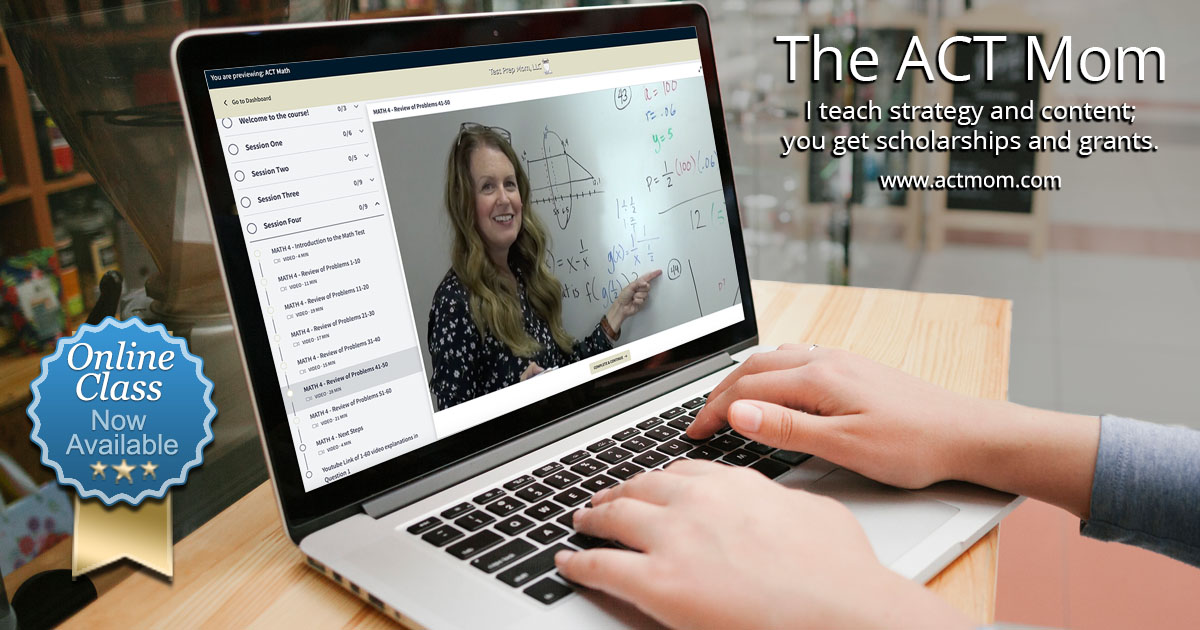
Somehow we went from our first year of homeschooling him in first grade to having a high school sophomore in the blink of an eye. Suddenly, I have to think about college, scholarships, transcripts, and college testing. I am not sure how time went so quickly, but I am grateful there are people and products out there designed to help me through this process. This month we have been reviewing the ACT Mom Online Class, a product from ACT Mom designed to help him prepare to take the ACT.
ACT MOM Overview
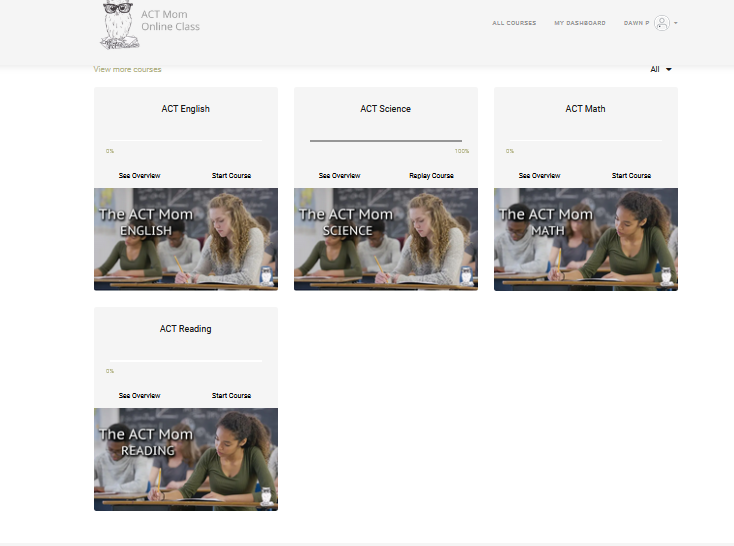
This online course is broken down into the four categories of the ACT:
-Science
-Math
-English
-Reading
Inside of each category are multiple lessons breaking it down into different topics. My son decided to do science first. There was an introduction to the course at the beginning (it is available in each category but only needs to be watched once.)
ACT Science Prep
Then there were seven sections. The sections were fairly short and he mostly completed a section each time he did a session. The first one was about how the science test worked and test taking strategies. There was a section about outside information questions, which are the science based questions that are testing your prior science knowledge.
Some examples of the test taking tips were reading the questions first to help you find the right information in the reading and stay hydrated, drink water and have protein bar in between the 2nd and 3rd sections
There were quizzes that checked for understanding of this material. Those were completed and graded online.
The rest of the science sections were broken down by the five sections that will be on the test. Each section had a science based reading selection and a set of questions. There was a 10 Minute video with each one that went over what section was about and then a timer for you to complete the section.
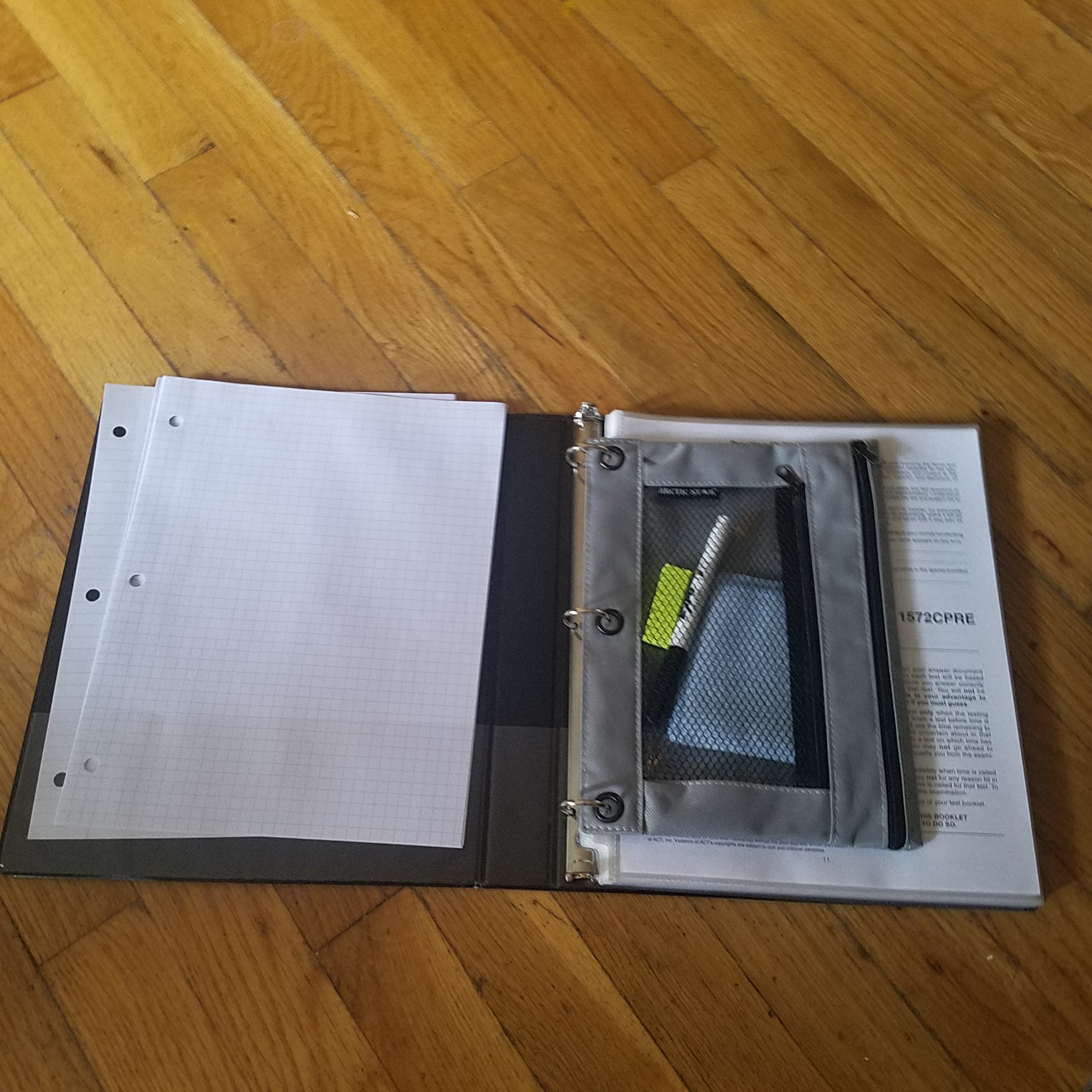
The course came with a three ring binder that had laminated sample answer sheets, graph paper, and other materials. When you came to these sections of the science lessons, you fill out the answers on the laminated answer sheets with a dry erase marker. This gives students a chance to get familiar with the layout of the answer sheets.
Students would answer questions for that section while the timer ran. They had 6-8 questions per section, and then there was a 2nd 4-5 minute video that explained the answers and where the answers were found.
Paper Materials for ACT Test Prep
Test Prep Overview
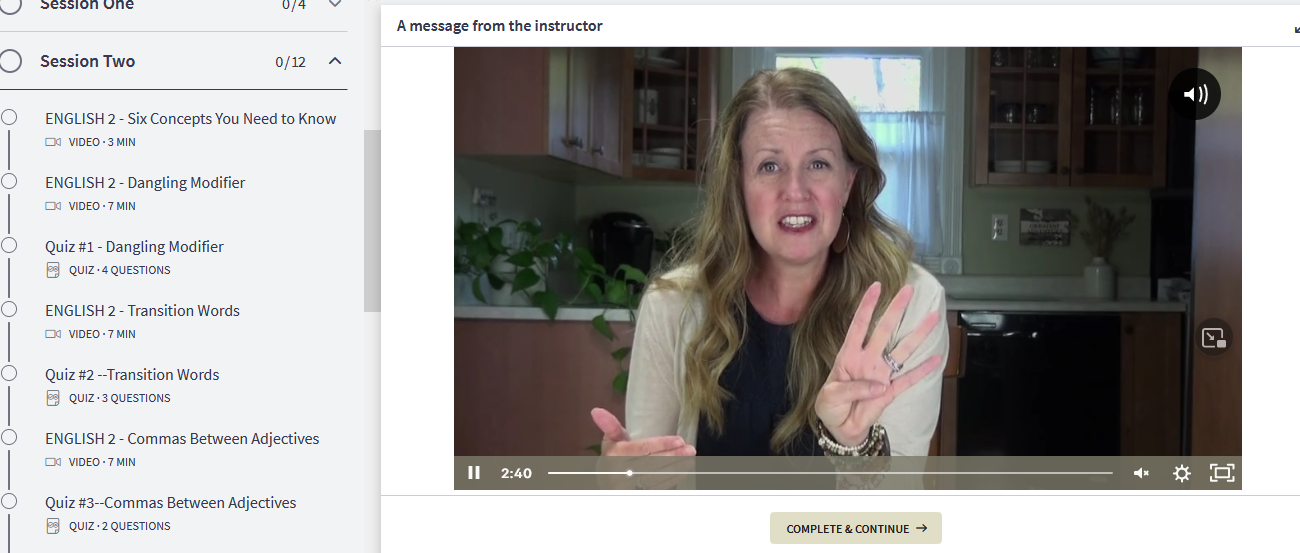
The other categories were set up similarly, with each one being broken up into different sections. For the math there were explanations of various math concepts with the digital quizzes and then at the end there is a practice ACT section. For that one she did videos that explain the correct answers and broke it into 10 questions per video so that you only had to go back and look at ones that you had trouble understanding.
Final Thoughts
Overall, while my son wouldn’t tell you that he enjoyed ACT Mom Online Class, he did feel like it helped him have a better understanding of what to expect when he takes the ACT. He felt like it was going to help him be more prepared and consequently score better. We plan for him to finish the program over the course of this semester prior to taking the ACT next year.
We do recommend this program for any high school student who is preparing for the ACT. I think it would be somewhat helpful for the SAT as well but it really targets the ACT set up and style.
Many of the Review Crew families took a look at ACT Mom Online Class and started with different sections. So be sure to click on the graphic below to see what they thought.
Some links are affiliate links, see disclosure below*
We are starting our 10th year of homeschooling this fall. In some ways it seems like just yesterday that I was sitting down with my first grader and trying this ‘homeschool thing’ for a year or two. Many things have changed over the years; we have added two more children to the family, changes our style and curriculum, and the children have gotten older (obviously) and more independent.
When people talk about their concerns about homeschooling, high school is a topic that comes up frequently. Even those families that have a strong desire to homeschool all the way through, often worry about how to homeschool high school.
Having only successfully completed one year of homeschooling high school (with 15 more to go altogether), I do not claim to have all of the answers. However, I thought I would share what homeschooling high school looks like in our home.
Something Stay the Same
Somethings look the same in our homeschool for high school as they did in earlier years. We still try to start our day as a family with Bible, hymn study, and read aloud. I do not include most of this on my sons records, but I think the time together is still valuable.
As in years past, we use a variety of curriculum and materials for our courses. For everyone’s sanity we switched over to online math for pre-algebra and beyond. (We have used several different programs but the two my son liked best are Thinkwell Math and Unlock Math).
We are using a variety of courses from SchoolhouseTeachers.com for him this year, just as we have the past several years. I love that I can use their literature courses to give him a good foundation in literature while allowing us to continue to use discussions as a big part of the literature process.
We are also still enjoying the opportunity to set our own schedule and have flexibility in when we ‘do school’.
Some Things Look Different
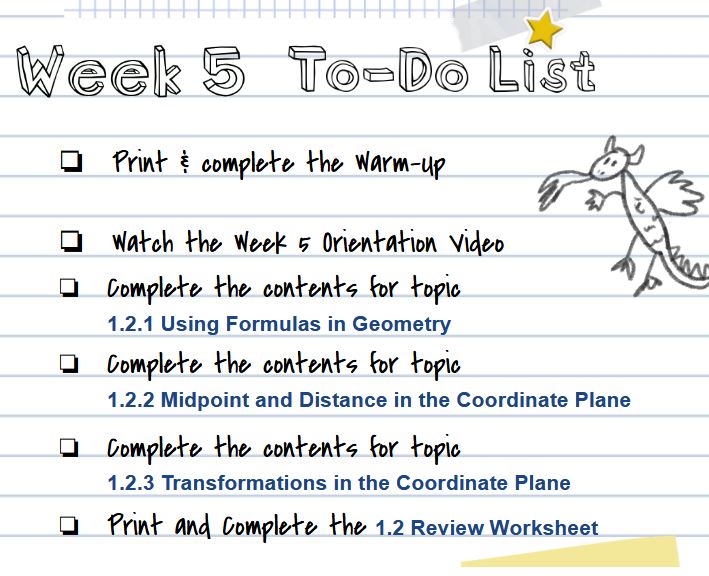
I mentioned above that we have flexibility in our schedule, but I do find that we need a bit more time in our school day to get the high school level work completed. For us that is about 20-25 hours each week. My younger students can get most of their work done in about 3 hours a day.
Instead of doing all of our courses throughout the year we are doing a hybrid block schedule. Some courses we do all year long. These include courses like music performance where he is counting hours towards completing and also literature to allow him a bit more time for reading the novels. Other courses, such as history, science, and math he is completing in a semester. This allows him to spend more time on each course each day.
Another big change is that every course is graded. Prior to high school most of our work was done and worked on until it was completed well and I felt like the material had been mastered.Some of the grades are assigned by the curriculum (his online math), some I grade with a rubric, and others such as his online course from Journey Homeschool Academy include grades done by them as well as components that are graded by myself.
I track all of his final grades in Fast Transcripts so that they are ready for sending in to colleges or scholarship applications.
For us high school basically has a bit more structure than earlier years. I track the number of weeks he works on his courses, keep track of grades, and require him to be a bit more independent.
Counting the Extras
One big key that we have found to balancing it all, is turning his hobbies and extra-curricular activities into a part of school. This frees up some time and keeps us from being too busy (though we still feel plenty busy these days).
For my son this means that he is taking Music Performance as one of his electives and that involves his Practice Monkeys lessons, worship band practice, and some additional course work that I am assigning him.
He is also taking Animal Science this year which will include his 4-H presentation, raising animals for the livestock show, and additional course work.
Additionally, I will be using the paper he writes for North Carolina Junior Historians as one of the papers he needs for English. This way he is still getting the writing done, but he gets to count it towards school and an extra-curricular.
By incorporating those hobbies into his electives, it helps to lessen the amount of time he has to spend on schoolwork while still ensuring that he gets a good overall education and is well prepared for college or the work force.
Overall, for us high school involves spending four to five hours a day on school work and then devoting additional time to projects and hobbies that all work together to create a well rounded education. We needed a bit more structure than we had in younger years, but still have much more flexibility than a traditional school environment.
Resource Library and Affiliate Disclosure
When you sign up for the Schoolin’ Swag free resource library you will get a link and password to the library, we are adding to the library each month with new items. You will also get a bi-weekly newsletter email to keep you up to date on what we have going on.
This post may contain affiliate or referral links, including Amazon affiliate links. As always I will never recommend a product that I don’t believe in and you will never be charged more for purchasing through our links. It does help pay for the costs associated with the blog.
Every year, sometime in August, I get at least one family who decided last minute to homeschool and wants to know how to make the switch. Maybe school starts in a couple weeks (or days), and you just know it isn’t right for you, or maybe you started back to school and really want to bring your children home.
You CAN do this!
Take Your Time
First, take some time to breathe. Do what you need to do to register as a homeschooler in your state, bring your child home, and take a few days to enjoy time as a family and get prepared to start. You do not have to keep the same schedule as the school system and it is OK to take a few weeks to prepare.
Spend some time making goals for your homeschool, researching homeschool styles and philosophies to see how you want to set up your curriculum. Talk to your students and get their input. It might make you feel like you are getting behind, but the time you spend preparing will save you time and frustration moving forward.
Curriculum
I am often asked, “What is the best homeschool curriculum?” There is no single right answer to that question. The best is the one that works for your family. I have spent hundreds of hours reviewing curriculum, and I can tell you that there are many wonderful programs available, and what works for one child may not work for another.
When you are getting started, I recommend buying used curriculum. When you buy used, you can resell and get most of your money back if you find it does not work for you. This often helps give families flexibility as they determine what will or will not work for them. I also highly recommend doing a little research into homeschooling philosophies to help you narrow down your options. There are some great free tools to help with that in our How Do I Get Started Homeschooling? post.
Find a Flexible Program
Another great option is to try a program like Schoolhouse Teachers. We love Schoolhouse Teachers because, with only one membership, we have access to a wide variety of courses (over 400 from preschool to high school). If we try one course and it is not a good fit for us, we can simply switch to a different course within the membership.
The membership is also good for the budget because it covers all of the students in your household. There are text-based courses, video-based courses, grade-specific courses, and family-style courses all included. We are using our membership for several courses for each of my students this year.
Final Thoughts and Encouragement
There are links to some great homeschooling resources at the bottom of this post, but mostly I want to leave you with the knowledge that you can homeschool. If you are being called to homeschool, God will provide you with what you need to make it work. You taught them how to eat, speak, and walk, and you can teach them academics.
Reach out if I can be of any help getting you started, and make sure to click on the graphic below to read the posts from all of the other Crew Members and enter the giveaway for a free Schoolhouse Teachers Membership.
When you sign up for the Schoolin’ Swag free resource library you will get a link and password to the library, we are adding to the library each month with new items. You will also get a bi-weekly newsletter email to keep you up to date on what we have going on.
This post may contain affiliate or referral links, including Amazon affiliate links. As always I will never recommend a product that I don’t believe in and you will never be charged more for purchasing through our links. It does help pay for the costs associated with the blog.
Deals and Freebies
If you have not tried SchoolhouseTeachers.com, you don’t want to miss this sale: Buy One Year Get A Second Year Free!
*Some links are affiliate links, see disclosure below*
My oldest will be in 10th grade this year. It feels almost unbelievable, as it feels like just a few years ago he was in first grade and we were starting our first year of homeschool. Last year we learned a bit about what worked well for us and what did not for high school level courses.
As always, there are many great options, you just have to find the ones that are right for your family and your child’s strengths and goals.
Thinkwell Math
Math
First, we were blessed with the opportunity to review Thinkwell Math for geometry last year. This went really well for us and I loved that he could go to office hours to get help each week if needed. They also allowed for a flexible schedule so that we could take our breaks on our schedule.
We enjoyed the combination of support with flexibility and are signed up for Algebra II with them this year. I purchased the self-paced course and we will add in the office hours if we see that he needs the additional help.
I love that while I am available to answer questions, he can complete this course with very little input from me (it has been a few years since I have taken upper level math courses.)
Literature
We used Schoolhouse Teachers last year for literature after our original plan did not work well and plan to continue that for this year. Last year he took a course focused on Tolkien and this year he is doing a course that covers a variety of British Literature. For literature, he will read and answer the questions that come with the course. We will then discuss the questions together.
History
He is going to take a Modern World History Course from Schoolhouse Teachers. We did ancient history last year and wanted to make sure he had a good foundation in modern history before we move on to US History and Government. This course is set up with readings, writing assignments, maps, and activities.
He will complete most of the assignments on his own and I will grade them. We will also have some discussions about what he is learning and add in a few documentaries.
Livestock Show 2021
Electives
He wanted to take Horticulture and Animal Science for two of his electives. These courses tie in very well to the hobbies and extra-curricular activities he was already doing. They also fit well with his college goals. To facilitate this, I am using 4-H and FFA materials as a guide.
We will also be adding hands-on projects including raising animals for the livestock show, growing a garden, and doing a 4-H presentation about one of those topics.
In the spring, he will be taking Culinary Arts. We are still working on the exact syllabus for this course. However, I know that we plan to use some of the course work from the Home Economics course at Schoolhouse Teachers and some episodes of Good Eats with projects based around the different techniques that he learns.
Playing for the Youth Group Band
Music
Last year he took Music Performance I and he really enjoys his music so we are doing Music Appreciation and Performance II this year. We plan to continue using Practice Monkeys for his guitar lessons. Last year he did guitar and violin but is planning to focus on guitar this year.
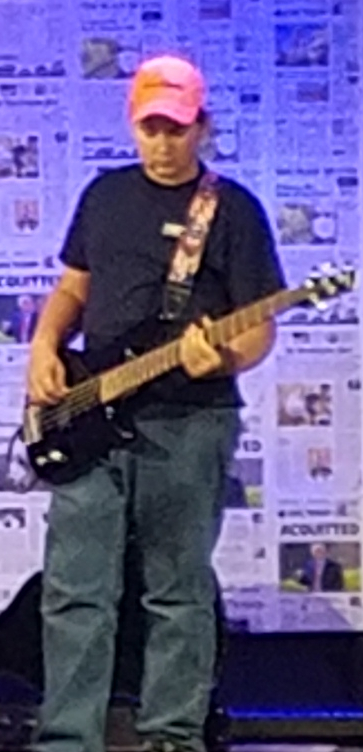
In addition, we will be using Schoolhouse Teachers Advanced Music Theory and SQUILT Music Lessons for theory and music appreciation. He also has the opportunity to play with our youth group band which gives him the opportunity to perform for other people.
Biology Lab with Journey Homeschool
Science
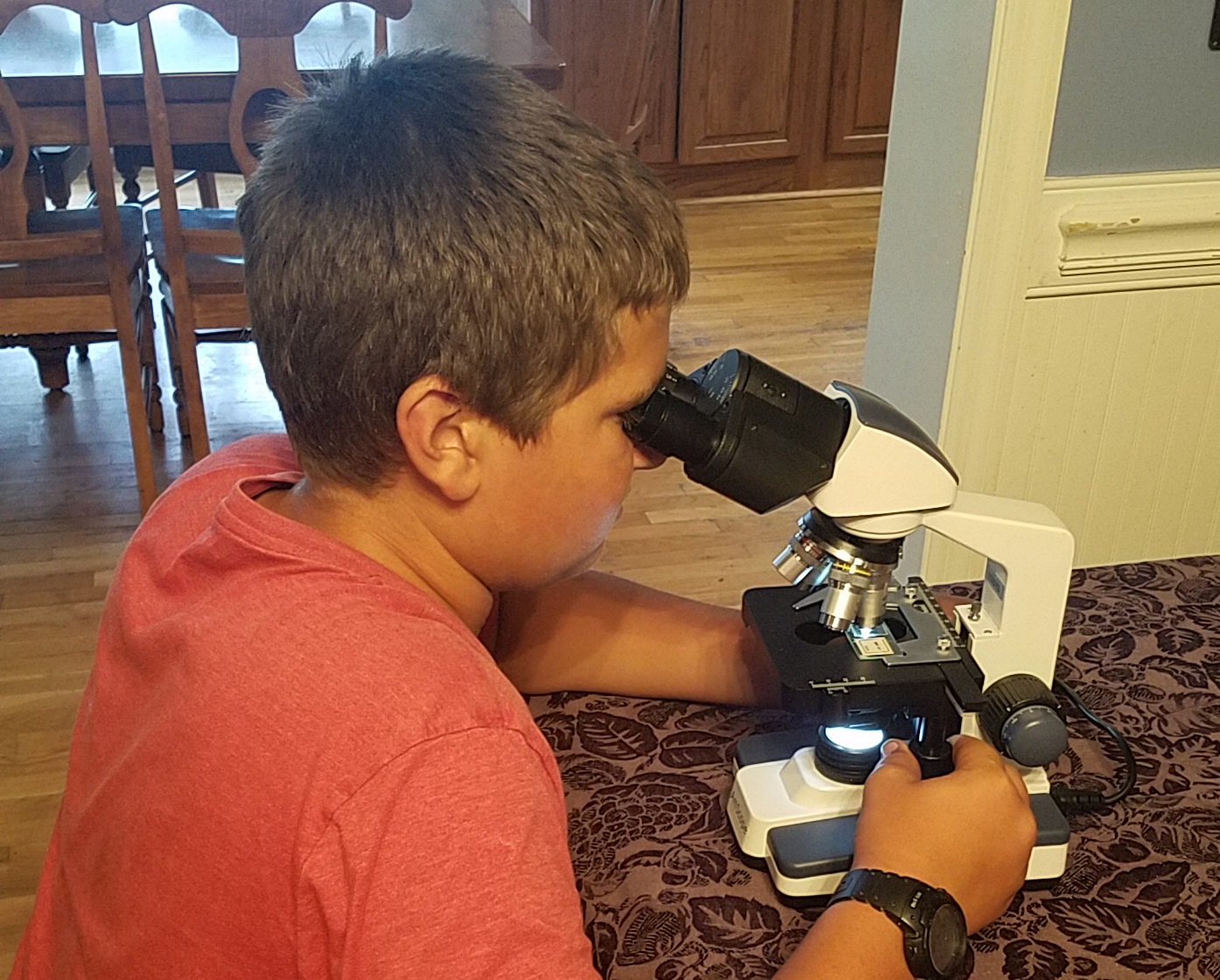
Last but not least is chemistry. Last year we reviewed the biology course from Journey Homeschool Academy. My son really enjoyed it, so we decided to try their new chemistry course this year. The videos were interested and easy to understand but also thorough.
There were tests that they graded and discussion questions and lab reports that I graded. It was so simple and required very little time on my part, which was important with everything else we had going on.
They have elementary, middle, and high school level science courses. All of their courses are done from a Christian world view. (If you are interested in Journey Homeschool Academy science courses their open enrollment ends at the end of August.)
Family Studies
He will be joining us for our Bible and hymn study time in the morning, but that will not count as a course. I still feel the family time is an important part of his development.
Overall, we are looking forward to a great year. Since my son wanted to be able to take a few extra days off this fall for hunting and fishing, he has already started some of his courses. We will stay flexible throughout the year as always and change if needed but I think we have a good plan for the year.
What courses or programs do you love for high school? Anything you are trying to find or need suggestions for?
Resource Library and Affiliate Disclosure
When you sign up for the Schoolin’ Swag free resource library you will get a link and password to the library, we are adding to the library each month with new items. You will also get a bi-weekly newsletter email to keep you up to date on what we have going on.
This post may contain affiliate or referral links, including Amazon affiliate links. As always I will never recommend a product that I don’t believe in and you will never be charged more for purchasing through our links. It does help pay for the costs associated with the blog.
Deals and Freebies
If you have not tried SchoolhouseTeachers.com, you don’t want to miss this sale: Buy One Year Get Another Year Free!
Not Consumed is offering 15% off everything in their store! Great Bible studies, hymn studies, missionary curriculum and more. Use Code: 2NDCHANCE
Evan-Moor is having a 25% off sale one all of their resources!
Use this link to get 15% off at Thinkwell Math! It was a lifesaver for us for Geometry and I look forward to using them for Algebra II next year.
Journey Homeschool Academy is offering a FREE Virtual Open House August 24 at 9pm. This is a great way to find out more about this science program and see if it is a good fit for your family. Get signed-up today!
In a world of catch phrases, social media memes, personal attacks, and news reporting that often has significant political leanings, it is important that we teach our children good logic and reasoning skills. This is something we had been working on with our children, especially the teens. So I was grateful to check out the book, The Fallacy Detective by Hans and Nathaniel Bluedorn.
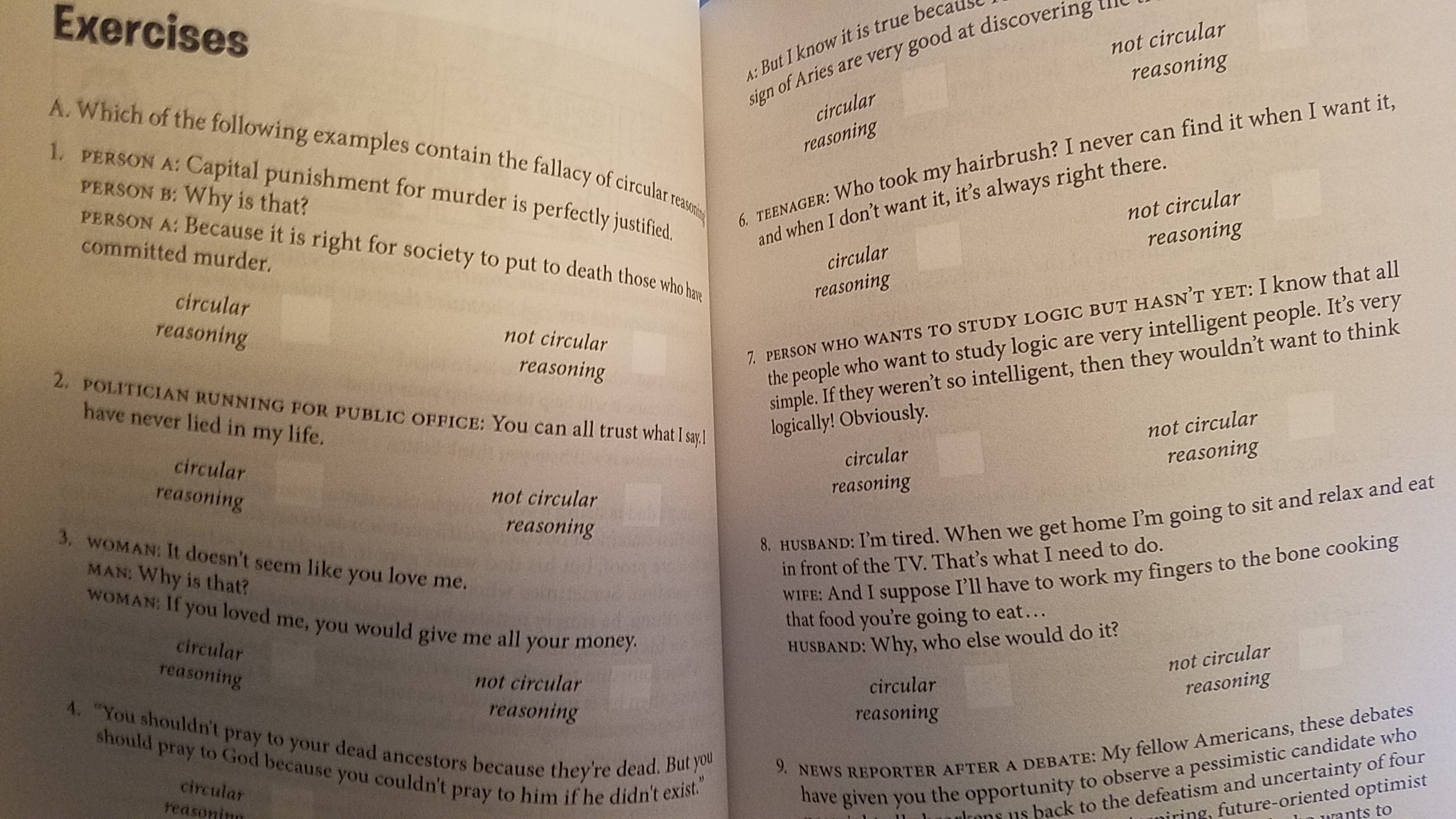
The Fallacy Detective has 38 lessons that help students understand logical fallacies. The lessons are short, each one being just a couple pages of reading and then a short worksheet to practice the skill. It took us about ten to fifteen minutes to complete a lesson.
How Did We Use the Book?
This book could be used independently by a teen and self-checked or checked by the parent (answers are in the back of the book). However, we wanted to make this book more of a place to start the discussion in our family.
Therefore, we did the lessons together as a family. I would read the lesson aloud and then we would go through the questions together. Each of my teens would give the answer they thought was correct, we would read the answer from the back of the book, and then we would discuss it as a family.
Several times we did lessons while were traveling. We were in the car a lot this summer for summer camp, vacations, etc and I wanted to use that time wisely. Another benefit of doing them in the car was that my younger children were hearing the lesson and discussion. I do not think the younger children are old enough to fully understand but I think it is good for them to start hearing the information.
What is a Logical Fallacy?
You may be wondering what I mean by logical fallacy. One example was Ad Hominem Attacks, which is where people attack the person with the opinion instead of the opinion itself. They gave examples of how this might look, and even explained that questioning someone’s honesty because of a history of lying was different than discrediting someone’s opinion because of their character.
Once they explained it and gave several examples. Then they followed it up with 13 1-2 sentence examples and had students determine if those examples displayed bad reasoning.
When you have finished all thirty-eight lessons, there are instructions for playing a game using the different fallacies. I think that will be a fun way to reinforce what we have learned.
Conclusions
Overall, we have been enjoying this book. I love that we were able to use it in a laid back family style approach. I feel that understanding logical fallacies is a very important life skill and I would recommend this book for any middle or high school students. ( A bit of a bonus is that the book was written by two homeschoolers and is a great example of a homeschooling success story.)
We plan to continue using the book by doing one or two lessons a week together until we have completed all thirty-eight lessons.
You can check out other reviews of the Fallacy Detective by clicking on the graphic below. Members of the Review Crew also reviewed another book by Hans and Nathaniel Bluedorn: Archer and Zowie. You can see those reviews by clicking on the graphic as well.
*This post may contain affiliate links, see disclosure below*
This week the Review Crew is sharing different ideas for providing encouragement and incentives in your homeschool. I have gathered ideas for encouraging both your students and yourself. (Yes, sometimes even us moms need a little encouragement and incentive.)
Homeschool Encouragement For Moms and Students
For Students
One of the biggest motivators for my children is free time. When their work is done they can play, explore, and be creative. The understanding that working hard means more free time is really motivating for them.
For some students, grades are an incentive. We do not do a lot of grades in the younger years because I did not need grades to know how my students were performing. However, in middle school my daughter started an online math program that gave her feedback via grades. She was actually very motivated to keep that grade high and worked very hard to maintain an A average.
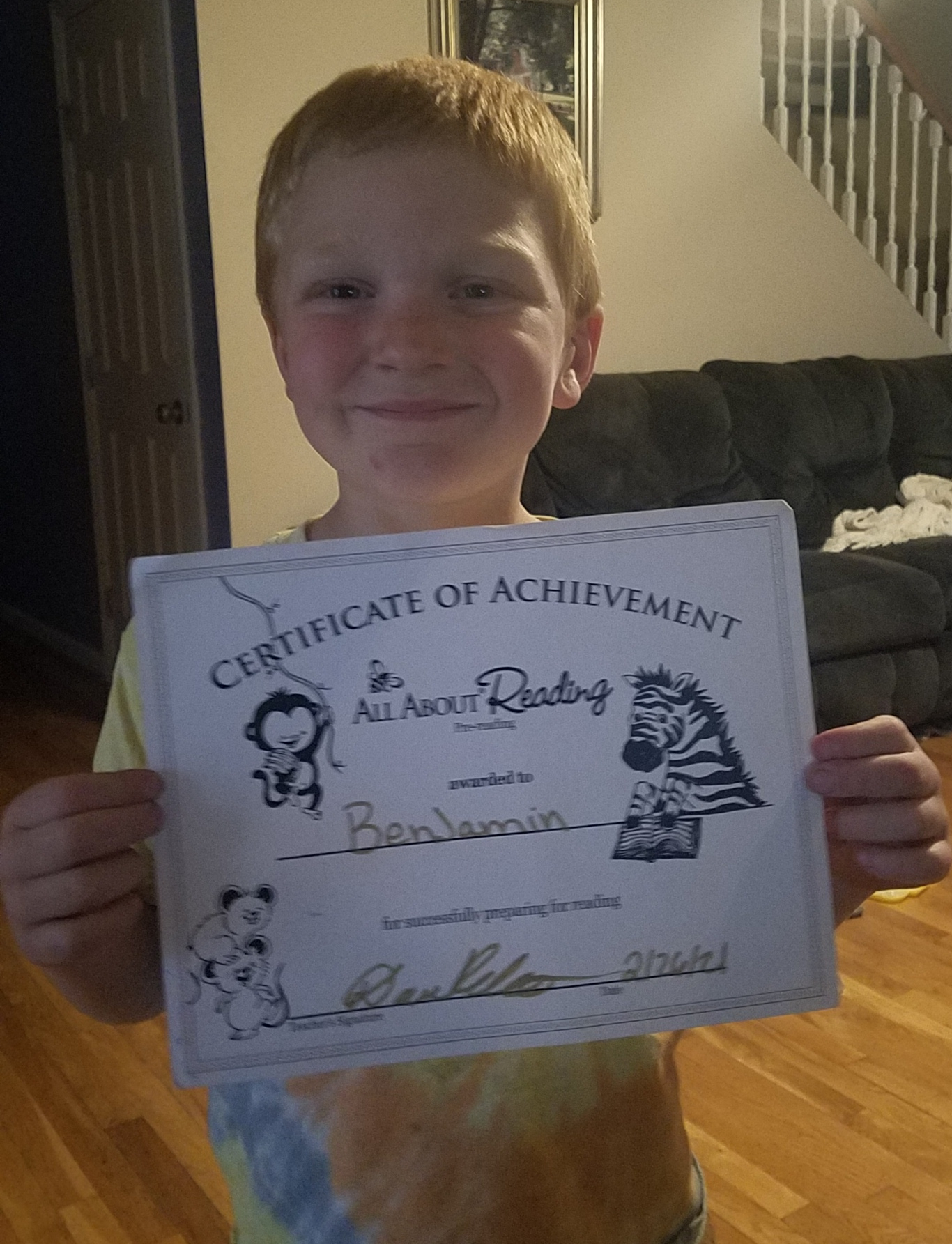
His Certificate for Completing a Level in His Reading Curriculum
My seven-year-old loves to be recognized for his accomplishments with certificates. If there is a certificate of completion with a book or program, he wants to do whatever it takes to get that certificate. We also give our children the chance to show good work to dad at dinner time or to grandparents when they come to visit.
Finally, set goals with your student. Allow them to set reasonable goals (with help from you) for what you will accomplish in a given time period. This might be over the course of a year or broken down into semesters or even each month. It can be powerful to set a goal and accomplish it and it often helps them to see the growth that they may not realize is happening in the day-to-day.
Encouragement and incentives do not have to be a big deal, sometimes it really is the small stuff that encourages students.
For Moms
I think homeschool moms often need encouragement more than our students. Homeschooling is worth all that we put into it, but it is not easy and it can sometimes feel overwhelming or fruitless (but it is not fruitless.)
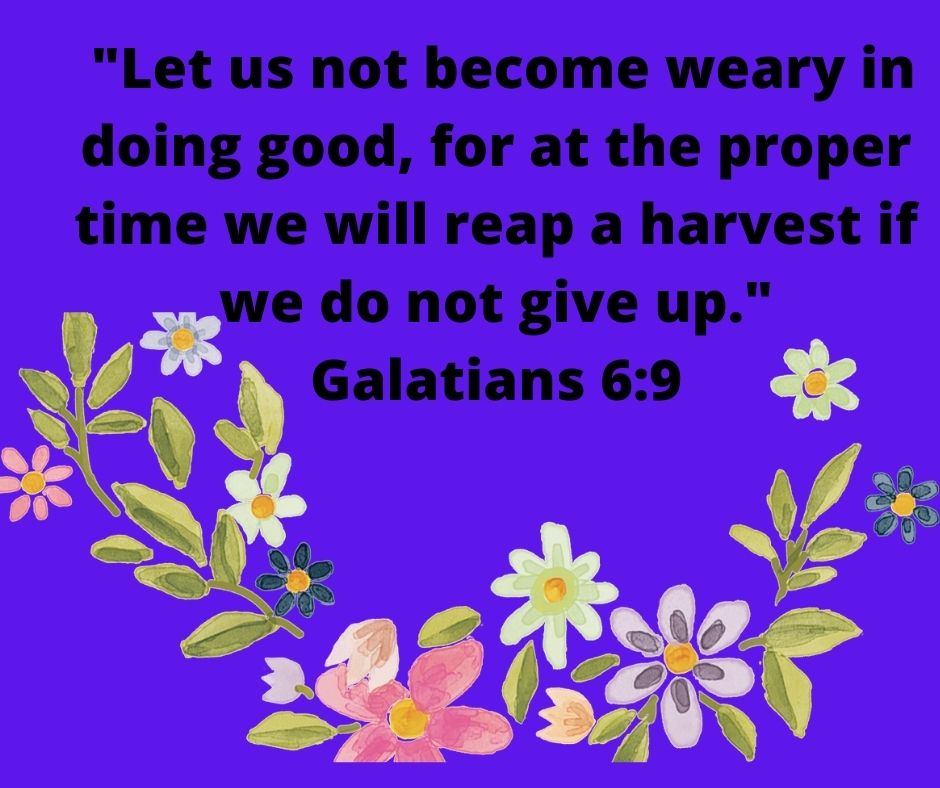
Scripture: Find a verse or two that you can lean on when times get hard and the days are long. Galatians 6:9 is one of my favorites. This post from A Diligent Heart has some other great verses for homeschool moms.
Books: There are many encouraging books for homeschool moms. A few of my favorites are Read Aloud Family by Sarah MacKenzie, Lifegivng Home by Sally Clarkson, Help! I’m Homeschooling! By Tricia Hodges. Check out all of my book reviews and reading list posts for more great book ideas.
Facebook Groups: Finding support from other homeschool moms can be crucial on those difficult days. Facebook groups can be a great way to have easy access to encouragement, ideas, and support. I love being a part of large like-minded groups and also smaller local groups that allow for facilitating field trips and events. If you are looking for a large group of encouraging homeschool moms check out the Schoolin’ Swag Facebook group to connect with thousands of other moms in a safe supportive environment.
Combining Mom’s Night with a Chocolate Dessert!
Moms Night Out: My friend Jen over at Homeschool Fanatic is great about setting up monthly local mom’s nights. We get to go enjoy good child free conversation and yummy dessert once a month. It is a great time of encouragement and refreshing.
Secret Chocolate Stash: Finally, do not underestimate the power of a good piece of chocolate on a challenging day. Take a quick minute, close your bedroom door, and enjoy your favorite treat. Sometimes, that can make all the difference in keeping a day from totally falling apart.
How do you encourage your students or yourself on difficult days? Share your ideas in the comments! Make sure to hop on over to the Review Crew page and check out all of the other ideas and enter the giveaway for a free Homeschool PAK!
Resource Library and Affiliate Disclosure
When you sign up for the Schoolin’ Swag free resource library you will get a link and password to the library, we are adding to the library each month with new items. You will also get a bi-weekly newsletter email to keep you up to date on what we have going on.
This post may contain affiliate or referral links, including Amazon affiliate links. As always I will never recommend a product that I don’t believe in and you will never be charged more for purchasing through our links. It does help pay for the costs associated with the blog.
Deals and Freebies
If you have not tried SchoolhouseTeachers.com, you don’t want to miss this sale: Buy One Year Get the Second Year FREE!