Math: A Love Hate Relationship

math-lessons-level-6

For years I created our own math curriculum because I couldn’t find one that was a good fit for my kids. We had a system that worked very well for our family. I would teach a concept like fractions to both children but take them each as far as they could go with the concept. We used lots of hands-on manipulatives and living books with math concepts.  Using the North Carolina Standard Course of Study for math, I made sure that each child was covering at least what was expected at their grade level and extending it where they were able. We did this successfully for five years, but with my oldest in middle school and a baby on the way we decided to try something new this year.  One day soon I’ll post more about how I created our own math but today I want to tell you about the math program we are using this year.

Math for a Living Education by Master Books has been a great fit for our family.  My son loves the fact that they tie in stories to the math. I have enjoyed that there is a review to help keep things fresh and lots of critical thinking and real world application. One of the biggest complaints I heard about math during my time teaching in a classroom and from my own children was that they didn’t need to know how to use it. This curriculum helps make the connection of the math problem to how it is used in real life.

In this season of our life, I also appreciate that the children can do this subject fairly independently. Each week their math assignments are listed on their weekly contracts and  they work on one lesson a day with an extra lesson sometime during the week, so that they complete five lessons during our four day school week. I try to check their assignments each day so that I can go over any they had trouble with and keep them on the right track.

We have needed to do school on the road quite a bit this month with several trips to the state fair and some other business travel. Having their math all right there in the book makes it very easy for them to bring on the road and and do (mostly independently) while we are riding. In these situations, I do need to make an extra effort to make sure I keep up with checking them so that if they are doing them incorrectly I catch it before they have practiced too many problems.

I know that with the new baby coming in February, it will be really important for them to be able to complete as much as possible independently for a few weeks while I recover. This curriculum will allow them to continue on with their math uninterrupted and is set up where my husband can easily check it for them each evening.

In this season and time, this curriculum has fit in nicely and eased my work load. However, I truly believe that there are no one sized fits-all curricula. There are many excellent curriculum options. Math for a Living Education stops at grade six so next year I’ll be looking for other options. Knowing that my son is advanced in some areas of math, on grade level in some and needs a little support with critical thinking it can be difficult to find the right fit. We are currently considering SchoolHouse Teachers because for one price I can get several different math courses to use to find the right fit. They also have some that are extra helps to support him in the areas that he needs to work on.

math_Facebook_1200x628-1024x536

I believe that he will be ready for Pre-Algebra next year and they have a class that looks like it would be a great fit, but if it is a bit too much, we can simply switch over to one of the other middle school level courses.  If you have a math program that is mostly working for your family but you want a little extra help, check out their Daily Math which is a collection of supplemental resources that you can use.

What has your family found that works for math? I’d love to hear from you in the comments what math curriculum your family loves or if you are still searching for the right fit.

Deals and Freebies for the Week

Diabetes Quick Study Freebie

The Green Ember is only $2.99 on Kindle or Free with a KindleUnlimited Trial

Check out the new Bible art course and  from You Are an Artist. They have some great stuff coming out!

If you are looking for some maps to help extend your geography check out these from Knowledge Quest Map Trek (including a free sampler).

Free gratitude journal: https://writeshop.com/free-gift/ref/dawnpeluso/

Homeschool Buyers Co-Op is offering a great deal on Discovery Education Streaming right now. 60% off and bonus Smart Points redeemable for other products. We have used this in the past and enjoyed it.

Two Free Audio Books with an Audible Trial and if you aren’t sure what to start with I’d suggest checking out the Green Ember or The Penderwicks for good family choices.

Check out this fun idea for using Salt Trays for Writing Practice: https://blog.allaboutlearningpress.com/salt-trays/…
These are from All About Learning who created the Awesome spelling program that was a game changer for us, All About Spelling (https://www.allaboutlearningpress.net/go.php?id=1468)

Our Friends over at US History Through Flags are doing a great giveaway for a free flag! Check out their October 19th post, Giveaway ends October 31st.
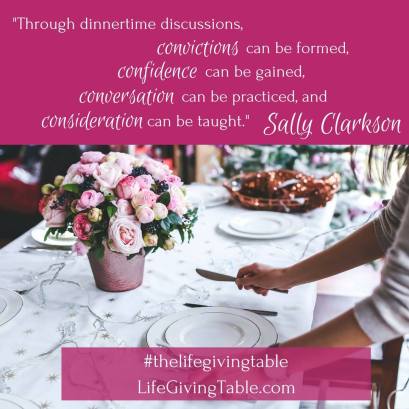
 

The Lifegiving Table Chapter 5

21728716_10213805635280222_8281159918214882823_o


If you are following along in the Facebook group, you know we decided to only do one chapter this week. It seems October is a busy month for many of us and I wanted to give everyone a chance to catch up and really focus on the reading.  As I went through chapter five with my highlighter, I felt like I had to stop myself from highlighting whole pages. So much truth and wisdom that I wanted to remember and share on each page that it was hard to choose what to focus on.

One of the main points of this chapter that really resonated with me was, “Convictions aren’t memorized; they are digested.” (pg. 74). She went into further detail earlier on that page explaining that while teaching is important the real difference comes when that truth becomes a part of someone’s life. In some ways it can be easy to teach our children what we want them to know but harder to make sure they internalize it as a conviction in their own hearts. The time we take at the table to discuss and debate ideas and thoughts can help them make this transition to convictions.

“Let your Conversation be gracious and attractive so that you will have the right response for everyone.” (Colossians 4:6)

I had never thought of this verse in light of the fact that Paul was limited in what he could write and he still found this to be important enough to write about. Our conversations are so much more important than we often give them credit for. People form opinions about us, our families, and more importantly our God based on how we communicate with them. Communication and specifically conversation are important to our lives and our faith. As such we need to work with our children to learn how to have gracious and attractive conversation.  I’m thankful for today’s digital communication in that I can keep up with family and friends that are hundreds of miles away. However, I see how our digital communication seems to be hurting our personal conversation skills. In light of that, I realize that I need to be more purposeful of teaching my children how to have good conversations and in making a point to invite those conversation with the people in my life. I need to take time for tea and conversation whenever possible.

I love music in a variety of forms, from praise music on the radio, to the old country that we turn on every now and again, blue grass concerts at the state fair, and our wonderful North Carolina Symphony. However, my musical abilities stop at the ability to enjoy the music and turn on the radio. I never thought I’d compare myself to a conductor of an orchestra but I love Sally’s comparison. On page 79 she said, “At our table, I pictured myself as the conductor of an orchestra and sought to make our table a place of harmony.” I know that harmony is sometimes hard to come by with children of varying ages and personality. I have a three year old that does not have much patience for long conversations, especially if he isn’t the one talking. Then there is the nine and eleven year olds that don’t share the same sense of humor and tend to clash if one of them feels slighted in the least. I need to spend time with my family rehearsing graciousness and conversation until it becomes part of our family culture. The more we practice and I coach or ‘conduct’ our conversations the more it will grow to be our regular rhythm.

“Table-Discipleship Principle: Shaping the mind and heart through repeated discussions about truth, beauty, and righteousness and engaging in these ideas regularly shapes convictions that last a lifetime. “

How are you orchestrating the conversations around your table this week? What topics are you hoping to discuss with your family or friends? How can you make your conversation gracious and attractive? I’d love to hear how you are applying this book in your life. It is really helping me be more aware and more intentional even through the toddler tantrums.

If you haven’t got your copy of the book, check it out here. Also there is a great study guide that goes deeper into scripture related to the life-giving table. Finally, if life is busy right now ans you are having trouble keeping up you might want to check out the audio book on Audible. If you have not tried Audible before you can get a 30 day free trial which includes 2 free books that are yours to keep even if you cancel the trial.

When you sign up for our free resource library you will get a link and password to the library, we are adding to the library each month with new items. You will also get a bi-weekly newsletter email to keep you up to date on what we have going on.

Resource Library

This post may contain affiliate or referral links. As always I will never recommend a product that I don’t believe in and you will never be charged more for purchasing through our links. It does help pay for the costs associated with the blog.


Revolutionary War Week 3: Rations and a Revue

20171016_123252(1)

History was certainly tasty this week! Using the list of rations that were supposed to be issued to a Revolutionary War soldier, my eldest son cooked us a great lunch. We had corn bread, peas with salt pork, Rice sweetened a bit with molasses, and root beer (I thought hard cyder (period spelling) was taking it a bit too far so we improvised) to wash it all down. While we know that unfortunately they often didn’t have all of these things due to shortages it was a neat experience for them to learn about the foods that they were supposed to have. We also talked about the fact that while it was very yummy for lunch, if we had to eat those foods everyday we would get tired of them.  We also had a good discussion about the fact that location and season would have played an important role in what was available. There was one list of rations approved by congress but we know the reality varied a great deal based on where the troops were located. Some had more flour, some more rice or corn. Some had easy access to fish, while others had more salt pork or beef. I have uploaded a list and explanation of the rations into our free resource library.

We had a chance to watch a live webcast from our North Carolina Museum of History which discusses small artifacts. it shared how it didn’t take big objects like ships or cannons to give us important information. It also went through some of North Carolina’s and America’s history by sharing artifacts found with-in the museum. It was a great program and you can watch a replay of it on Youtube: Small Stuff/Big Stories.  It does appear that because of the nature of the live taping an such you need to fast forward to about the 14 minute mark to get the actual webcast to start playing.

On Wednesday we had the opportunity to attend the North Carolina State Fair and particularly the Military History program. Various groups from the North Carolina Cultural Resources department were there representing the wars in American history. Each group had a table and display set up throughout the day and this highlight of the day was a historical uniform revue. This is set up similar to a fashion show, those there from each group were called up on stage and someone described and explained their uniform. This particular revue started with a soldier dressed as one that would have come with the first English colonist to Roanoke Island and went through the Vietnam War.  My husband was participating as a historical interpreter with Tryon palace. Their group represents a Continental Line unit. Aside from him being my obvious favorite, I really enjoyed the fact that the soldier representing the Vietnam War was wearing the uniform he actually wore in the Vietnam War.  I did my best to get pictures of each group, though the sun was not being exceptionally cooperative. I have included photos of as many groups as possible in the slideshow below. I am planning to use these pictures to help the children remember as we get to those times in history this year.

This slideshow requires JavaScript.

Next week we should be back to a more normal routine as our adventures at the fair are over and it’s time to settle back into the books a bit. We plan on doing another art lesson from You Are an Artist, reading some more in America’s Story Volume 1, and working on finishing up our projects. If time allows, the children want to watch a couple more episodes of Liberty’s Kids. Matthew was very interested in the rations that we looked at last week so we may be trying some other recipes this week.

When you sign up for our free resource library you will get a link and password to the library, we are adding to the library each month with new items. You will also get a bi-weekly newsletter email to keep you up to date on what we have going on.

Resource Library

Finally, don’t forget there is only a few more days left to take advantage of the great sale at Schoolhouse Teachers! With this sale you can have the curriculum you need for all of your children for  about $10 per month and you can try it for $5 for your first month.  They have everything from core classes, to art, music, and other great electives.

This post may contain affiliate or referral links. As always I will never recommend a product that I don’t believe in and you will never be charged more for purchasing through our links. It does help pay for the costs associated with the blog.

Is the Fair Educational?

We have a family tradition of going to the NC State Fair in Raleigh every October.  The kids have really enjoyed it over the years and despite the crowds and prices we feel that it’s a positive experience for our family.  Sometimes though, the fair is what you make of it.  It’s really easy to get wrapped up in rides, turkey legs, and deep-fried candy bars, and that’s okay if you’re just looking for entertainment.  As homeschoolers we want to make the most of opportunities, so we make a conscious effort to steer our attention towards the more educational or enriching aspects of the fair.

There are so many different educational opportunities at the fair, one of the ones most people think of first is the livestock and animal shows. In previous years, we have enjoyed seeing all the animals, learning about them, and even milking cows. New to the barn this year was a large incubator where folks could watch chicks hatching out of their eggs. That was one of the things my three year old has been talking about since we left the fair. This year my children had the opportunity to participate in a state fair livestock show for the first time. They showed turkeys which they had raised. They didn’t bring home the ‘blue ribbon’, but it was a great learning experience. They had to learn how to raise and care for the turkeys, proper showmanship, and good sportsmanship. There are so many lessons to be learned from watching or participating in the shows and animal exhibits, from basic animal knowledge to a better understanding of where our food comes from and an appreciation for all that goes into taking care of the animals.

Hand-in-Hand with the animals is the produce and pollinator section of our fair. We love bees and learning more about beekeeping. We have been bee-keepers for a little over a year now but still continue to learn from the experts at the fair. We also enjoy seeing all of the great produce. Much of it is familiar to us, but there is always some new variety that we had never seen. I think getting to see the largest pumpkins and watermelons is one of my oldest son’s favorite parts of the fair.  He spends most of our ride home talking about what he can do to grow one of these giant pumpkins. Some of these pumpkins weigh in at over a thousand pounds! There was even a new state record set this year for the largest pumpkin. My son has even started trying to grow one big enough for this competition. He also loves the large watermelons which can get to several hundred pounds. His largest watermelon this year was over 90 lbs and he hopes to enter one in the fair next year. This year he entered his Georgia Candy Roaster into the fair and was proud to get his picture with it on display. Both of my older children as well as several from our 4-H club also participated in a decorating contest where they decorated either pumpkins or sweet potatoes. These were displayed across from the other produce entries. This is a great chance to learn more about the food we eat, new varieties, and have an appreciation for the abundance that is available.

If you have been following along in our history series, you may recall that my daughter has decided that she wants to learn to weave on a loom. When we were in Williamsburg she was able to try her hand at a small table loom and seems to be hooked on the idea. She was very excited about another stop on our fair journey, the Village of Yesteryear. This building features a wide variety or artisans and craftsmen demonstrating their various skills.  She was delighted to find a weaver working on a large floor loom. This very kind lady, talked to her, allowed her to sit with her while she worked and showed her the steps in the process. In addition, we spoke to a basket maker, a gentleman making violins, a lady tatting jewelry and other items. There were many more artisans in the building and you could probably spend an entire day in their learning about how things were made and if you wish buying a few of those items.

20171013_142507
Elizabeth learning about the loom.

Another favorite stop at the fair is Smokey the Bear and the NC Forestry exhibit.  They have a large animatronic Smokey the Bear that talks to the children (and adults), as well as multiple tents and booths set up to talk about forest conservation, forest fires, soil health, and other related topics. They even have a helicopter the children can sit in and learn about using helicopters and planes for fire control and forestry.  The children look forward to stopping here every year and they always learn something new.

20171013_155302
‘Putting out fires’ with NC Forestry

Our NC Wildlife and Marine Fisheries departments also have tents set up at the fair. The wildlife tent has animals the children can see, and even a pellet gun range for a bit of target practice. Marine fisheries has games, fish, a sand box to create a reef, and other educational activities about our rivers and sounds. The children enjoy these activities and get a chance to meet some of the folks that work to keep our land beautiful and clean as well as safe.

The North Carolina Department of Cultural Resources has several exhibits set up sharing information about our state parks and historic sites. We enjoy visiting these places on a regular basis but it was still interesting to learn about some of the ones that we have not been able to visit yet. This gives the parks and sites access to the public that might otherwise be unable to come directly to their sites or may not realize what they have to offer.  There was a map that you could place pins in to show where you had visited. My daughter enjoyed seeing all of the places we had visited and is excited to continue to explore.  They even had a hands-on station where they could make small clay pinch pots.

My husband had the opportunity to participate as a historical interpreter for the military through the ages demonstrations that were taking place on military appreciation day. He participated with the Tryon Palace Continental Line Unit with whom he regularly volunteers. The children and I were able to visit with them as well as the folks from the different wars in American history. They had a soldier from Roanoke Island Festival Park representing those that came over and defended that first English colony all the way up through the Vietnam War.  It was really interesting to see the progression. Each group had a table with information and was available to talk with the public and that afternoon they did a uniform revue which is honestly much like a fashion show in which each groups uniforms were described and explained. This tied in well with our Revolutionary War studies as well as giving us information that will be useful as we work our way through history this year.

There are many other educational opportunities at the fair and I think it is very easy to have a day filled with fun and adventure while being educational. Another perk to the ones I’ve mentioned above is that with the exception of milking the cow they are all free with admission to the fair. I can’t leave out my favorite part of the fair, Maple cotton candy. I love cotton candy and my oldest can’t normally have it because of the food dyes, but there is a great vendor every year that sells cotton candy made from pure maple syrup. It is so very yummy and while maybe not healthy at least better for you than the regular stuff. We really enjoy our adventure at the fair every year and would love to hear about what you love about your fair.

Resource Library and Affiliate Disclosure

When you sign up for the Schoolin’ Swag free resource library you will get a link and password to the library, we are adding to the library each month with new items. You will also get a bi-weekly newsletter email to keep you up to date on what we have going on.

Resource Library 

This post may contain affiliate or referral links, including Amazon affiliate links. As always I will never recommend a product that I don’t believe in and you will never be charged more for purchasing through our links. It does help pay for the costs associated with the blog.


Great Sales and Deals and Freebies

Sally Clarkson just launched her newest book, a devotional for moms! You can purchase it at Amazon now .

We have been listening to Alice in Wonderland on audiobook to prepare to watch a live version of the play this week. I had forgotten just how ‘crazy’ the book feels. If you are interested in listening to it, it is only .66 on audio right now.

Free Makeover Your Morning 5 Day Challenge! This is a great way to help re-focus and get your day off on the right foot.

Harry The Happy Mouse (Free on Kindle)

Illustrated Would You Rather Book (Free on Kindle)

Free Help Your Child’s Memory Book from All About Learning Press!

Homeschool Buyers Co-Op is offering a great deal on Discovery Education Streaming right now. 60% off and bonus Smart Points redeemable for other products. We have used this in the past and enjoyed it.

Two Free Audio Books with an Audible Trial and if you aren’t sure what to start with I’d suggest checking out the Green Ember or The Penderwicks for good family choices.


Lifegiving Table: Chapters 3-4

“Creating an environment of beauty, comfort, and acceptance cultivates hearts that are open to your messages.” Sally Clarkson

20245696_10215064045654118_6408138499872325561_n

It is so important that we cultivate the environment of our home and our table. We need to study and understand each of our children and our guests and prepare a place that is beautiful and comfortable for them; in doing so we help cultivate their hearts to be ready to hear the message that we have to speak in their lives. I really love how Sally talks about realizing each child’s individual needs and making time for them.  It can be so simple, it doesn’t have to be a fancy dinner out or a whole afternoon alone, a simple 15 minute tea time to connect. In our house tea is a favorite of one child, but with the other we use chocolate milk or lemonade.  Another trick I’ve used is keeping cookie dough balls frozen and ready to go. I can take out just a few have them ready in a few minutes with minimal mess.  Many different kinds of cookies do well like this but two of our favorites are oatmeal chocolate chip and Earl Gray tea cookies. I will post a printable of the oatmeal chocolate chip cookies in the resources by the end of the week.

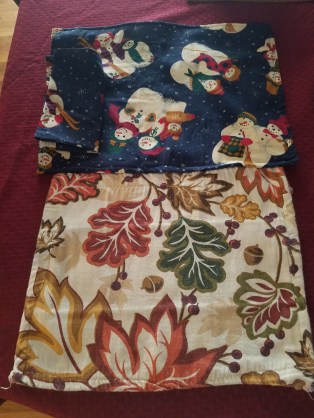
At one point in my life when people would talk about decorating or creating beauty I would get overwhelmed.  It seemed like it would be expensive and take precious time that I didn’t feel like I had. I have learned to I can do very simple, inexpensive things and make a big difference. For example, just putting a table cloth on our table makes it seem nicer (most of us already have a few tablecloths and if you don’t you can purchase them from yard sales or thrift stores for about a $1 each) and it makes the table easier to clean up when we are done.  My daughter has taken to using pieces of seasonal fabric to recover plain place-mats to give our table a seasonal feel.  Finally, my favorite trick is to simply buy either a small potted plant or fresh cut flowers for the table. I don’t’ buy the expensive ones, for about $4 I can get a nice bunch that will last me two weeks. Or I recently had a small potted plant for $6 that lasted for months. Every time I walked by my table it makes me smile.

20171017_115908

The Table-Discipleship Principle from chapter four was, ” Practicing the rhythms of life regularly with your loved ones creates a secure feeling of belonging-of being welcomed and able to share convictions and faith with a community where one belongs. ”  It is so important that our children find that sense of belonging both in our family and in God’s family. I think that so many of the struggles we see in society today stem from young adults floundering in a world where they are searching for belonging.  Traditions and rhythms don’t have to be complicated elaborate parties and events, and truly I think often the small things make a bigger impact.

In our family one of our favorite traditions is to have potato soup every time it snows. If you happen to live in a more northern climate you may be thinking you would get very tired of potato soup, but here in Eastern NC that is only a couple times a year.  It isn’t a complicated meal but they enjoy that tradition.  Another tradition that they look forward to is ice cream sundaes for lunch on Valentine’s day (don’t worry I add in some fruit to make it more balanced 😉 ).  Sally lists lots of her family’s rhythms on pages 55 and 56.

Sally talks a great deal about Romans chapter 12: 1-2 in this chapter of the book. This also happens to be the verse that we chose as our guiding verse for our homeschool this year. We live in a world where “anything goes” and a culture where morality is very subjective. This verse is a great reminder that we need to be transformed through the power of God and not of this world.  As we guide our children we need to keep pointing them to the Truth of His word. Our tables become a place where we can do that multiple times each day through our love and conversation.

How can create a family identity and culture this week? It looks different for each family. We have one family that is friends of our family and their last name is Reese. They call themselves “Team Reese”. Their family happens to be big sports fans and that is a way in which they communicate with each other and other people that they are part of the same team working together towards the same goals. Our family has taken to talking about how we can work together as a family to accomplish our personal goals and whatever God desires of us.  I’d love to hear in the comments one of your families favorite traditions or one way in which you are working to create a family identity.

If you have not yet gotten this book I encourage you to do so. You can find the book here or you can order it from Audible if you prefer listening to the book.  If you would like to join in our online book study for more discussion please join us here.

This post may contain affiliate or referral links. As always I will never recommend a product that I don’t believe in and you will never be charged more for purchasing through our links. It does help pay for the costs associated with the blog.


Revolutionary War: Week 2

20171013_112834
My son and his turkey at the state fair.


Sometimes your best laid plans go awry and you have to drop back and punt. This week we had many plans for history, but we also had a turkey show at the state fair which put us away from home for a couple of days and some other unexpected things that needed to happen.  This meant that to some extent history was paused for this week.

My son has a great meal planned using the “standard” rations of a Revolutionary War soldier. We had planned on doing that Thursday before we left for the turkey show, but timing did not work out. So he will be cooking that for lunch on Monday. I am uploading a great document with the typical rations for the northern campaign and the southern campaign during the Revolutionary War. This would of course have varied somewhat dependent upon where they were and what was available. In case anyone is concerned we swapped root beer for the hard cyder 🙂 (historical spelling)

I find each week homeschooling is a balance of the book work and the real life. This week real life needed more time. The kids really enjoyed the fair and showing their turkeys. My daughter who loves looms, got a chance to sit down with one of the weavers in Heritage Village at the fair and learn a few tricks of the trade. We also spoke to a basket maker and a violin maker.


Last night we watched Beyond the Mask to spend some fun family time together and learn a little bit more about the Revolutionary War. I don’t recommend this movie for small children or those that are very sensitive to violence. It is not overly graphic but does have fighting and battle type scenes. It is a mostly fictional story set during the time of the Revolutionary War. This is not the movie if you are looking for a documentary, but it is a beautiful story of the redemption of Christ in a historical setting.

We will have our meal this week as well as attend (with my husband and son helping) in a military through the ages program at the fair. This will feature some Revolutionary Soldiers as well as others up to current times.

What are you doing in history this week?

If you would like to join us on this journey through US History, join our mailing list and get access to our free library. Each month I’ll post a list of resources and ideas for the time period we are going to cover the next month. You can learn more in our post Our Journey Through History.  Colonial and Revolutionary resources are currently posted.

When you sign up for our free resource library you will get a link and password to the library, we are adding to the library each month with new items. You will also get a bi-weekly newsletter email to keep you up to date on what we have going on.

Resource Library

Our study of Sally Clarkson’s new book The Lifegiving Table is up and running and I am so excited about this book and the message that she is sharing. We can use our tables to disciple our children and all of those that come through our homes. We can give them rest, nourishment, comfort and so much more.  I invite you to join us on this journey as we study through the book. I believe it has the power to transform families.  To learn more or to join us in this study check out this post.


This post may contain affiliate or referral links. As always I will never recommend a product that I don’t believe in and you will never be charged more for purchasing through our links. It does help pay for the costs associated with the blog.


Can We Please Do Science Today?

From time to time I will review the curriculum we are using or host reviews of other curriculum to help those that are looking for the right fit. I truly believe that there are many great programs out there and that not every program will work for every family.  In writing these reviews I hope to give you more information in which to make informed decisions about what may or may not work for your family.

20171009_164413

In our first year of homeschooling I tried out several different science programs that just were not working for our family. My son is very interested in science and the programs we tried were too basic to meet his interest level. So I started finding various resources and piecing things together.  This can be a very effective method but it does take more time and planning on the part of the parent. During this process we were studying the solar system and a family member mentioned the Apologia Exploring Creation With Astronomy book and offered to let us borrow her copy.  I was very hesitant about the overall concept of one subject per year but more than willing to use it as a resource during what I planned as a one month study of the solar system.

Instead of a month we spent the rest of our school year (we started in January so basically a semester) using the Apologia book to study the solar system.  I couldn’t believe how much they were learning and how well it worked to dig so deep into the same subject rather than covering many different subjects. We did not finish the entire book (that is a lot of material for a first grader to cover in a semester) but my son knew more than planned about the solar system and even the four year old picked up information from listening to us read.

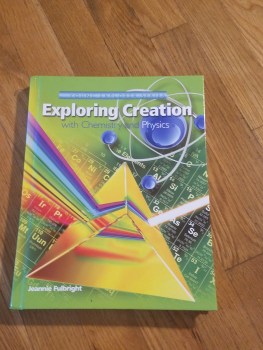
That experience changed our course for science. After a bit more research and prayer and a long talk with my husband we switched our science over to Apologia. Each year after that we have taken one of the elementary level books from that series and covered it together as a family. We have done botany, all three zoology books, and are currently working through Exploring Creation with Chemistry and Physics. The series is based on the days of creation and goes through and studies each topic in-depth. It is a creation based approach to science and ties everything back to the Creator which was a big positive in our experience. I also really appreciated that while it gave credit to God it didn’t short change the amount of science and information that was provided. It was very in-depth and thorough.

20171009_164429

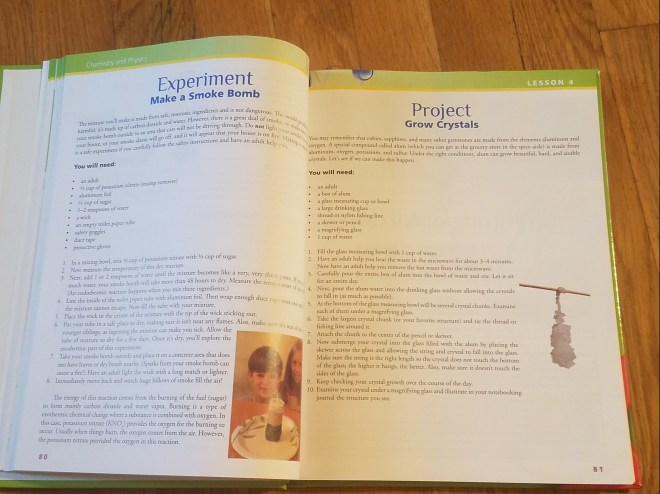
Each lesson includes “try this” activities which are like small quick hands on activities or experiments. There is also a larger experiment or two at the end of each lesson. A lesson equates to a chapter and takes our family about two weeks to complete. There are narration questions and breaks which tie-in nicely with our Charlotte Mason leanings. It is written in a much more living book style than a regular text book.

In addition to the text book they offer Notebooking Journals and Junior Notebooking Journals.  These give the students some questions, copywork, lapbook style activities, and other potential hands on activities to go with each lesson. They also have templates for taking notes which helps them develop that skill (especially in the Notebooking Journal).  In addition, there is a list of additional books, videos and other resources to accompany each chapter. I love that it is easy to adapt. My daughter loves the lapbooking style projects but my son does not. However, since the information is in their in several ways I just assign them the pages that work best for them.  When they were younger we even shared a journal with each of them doing half the pages.

We are just finishing up lesson two in our current book but are already enjoying the experiments. Chemistry and physics do lend themselves to even more hands-on activities than some of the other topics. We have done experiments involving freezing various liquids, making a “lava lamp” with oil and vinegar, trying to separate and rejoin water droplets, and several others. They made a terrarium last week with a plant to demonstrate the water cycle. I’ve included a few pictures from some of the activities we have done over the past couple of years.

Overall, we really love the Christ focused nature of the curriculum, the in depth study, and the variety of hands on activities. We also enjoy being able to do science together as a family and not a different curriculum for each child and my children frequently ask the question from the title of this post. It isn’t something the “have to do” but rather something they enjoy.

I know that not every family wants to delve so deeply into science in the early years. Maybe you have students who are not as interested or maybe you just want to supplement what you are already learning about. You might even use Apologia but want to add some other things to go with it. I have been looking over the science classes offered by Schoolhouse Teachers and I’m amazed at the variety of things that are offered. There are several that I think my children might like to do on their own as electives just for fun.

smallworldsensoryscience_Facebook_1200x628

While my youngest loves our science experiment most of the information in our current curriculum is above his comprehension (he is only 3) but he loves to learn. So I’m looking at adding this course to our calendar in January as something fun for me to do with him.  Small World Sensory Science sounds like just the fun and hands on type of program that he would enjoy. I have done some things with him, but I find that we are better about getting it done when it is all laid out and ready to go. Sensory bins and objects are a big hit with that age and should be great fun. They also work well to keep him occupied while I work with the older children on schoolwork.

A World of Animals is one of the ones that I want to show my older children. They have loved our studies of animals (including three Apologia zoology books) and are always wanted to learn more. I particularly like that this program includes sections on taking care of those animals which are potential pets. While we have all the animals I can handle at the moment (bees, chickens, ducks, turkeys, a cat, and a fish) they are always on the lookout for new pet ideas.

I would love to hear what science program is working for your family and why you love it! I’m also happy to answer questions you might have about what we do for science.

When you sign up for our free resource library you will get a link and password to the library, we are adding to the library each month with new items. You will also get a bi-weekly newsletter email to keep you up to date on what we have going on.

Resource Library

Our study of Sally Clarkson’s new book The Lifegiving Table started this week and we would love to have you join us.

Not Consumed is having a great sale on their hymn studies. These are great ways to includes holidays and seasons into your studies while also focusing on God.  We have used them in the past and really enjoyed them. Her missionary study (which we are using this year) is also on sale right now.

There is also a sale going on over at You Are an Artist. Everything is 25% off for Columbus Day through October 15th.

This post may contain affiliate or referral links. As always I will never recommend a product that I don’t believe in and you will never be charged more for purchasing through our links. It does help pay for the costs associated with the blog.

A Lifegiving Table: Chapters 1-2

20171003_195407

When you hear the words “lifegiving table” what comes to your mind? Is it the food that is necessary to sustain life? The fellowship and fun that comes at a family table? The communion table where we celebrate eternal life? So many different images come to mind but I think it is important to know that a “lifegiving table” can be a big fancy meal or a simple but nourishing meal. It can be a large family or two friends around a table. You can have a “lifegiving table” at a large dining room table or on a blanket in the park.  As I listened to Sally Clarkson speak last week she mentioned that she had figured out that over the course of 18 years at three meals a day we will feed our children over 19,000 meals. This really stuck with me as I thought about the impact that our time together and our table could have on our family and those that we invite to the table.

“All table-talk discussions, love given, and beauty cultivated at our table are for the purpose of making real our Savior and calling those who share life with us to serve Him their whole lives.” (Sally Clarkson, pg. 1 The Lifegiving Table)

Sometimes making meals three times a day (at least since mine tend to want snacks and 2nd breakfast) can be exhausting and monotonous. However, when I view it from the perspective of serving my family and pointing them to Jesus it gives me new vigor in the process. Each meal is an opportunity to “feast” with my family, to serve them, and to point them to Jesus. There are so many stories in the Bible that revolve around the table. The Passover meal which leads to the communion table, Jesus feeding the 5,000, the various Jewish feasts and celebrations are but a few examples.  We can see from those examples as well as examples from our daily lives that eating together around the table nourishes not only the body but the soul as well.

21457651_10214429425748513_7389917738969414229_o

Chapter two was written by Sally’s husband Clay and spends a great deal of time talking about the Biblical foundations of the “lifegiving table” to prepare us for the practical applications shared in later chapters. In this chapter he expounds upon the five key elements: gather, bless, eat, share, and serve. Clay shares wonderful examples of Jesus and how he served His disciples and those that were following Him. One of my favorite quotes from that chapter is, “A huge element of table discipleship is modeling and teaching what it means to be a servant”.  The example that Jesus provided in washing his disciples feet prior to his arrest and crucifixion is a prime example of how he showed servant leadership and led by example.

I could talk for pages about these chapters but instead I’ll leave you with one final thought and encourage you to read them for yourselves. I can’t do justice to the wonderful ideas written and shared within the pages. In the last section of chapter two we are encouraged to not only get food on the table but get the table in us. What does that mean to you? How can you apply that to your situation?

20171003_145745

I would love to hear your thoughts on these two chapters. Please feel free to leave a comment with your thoughts on the book so far or one thing you can implement in your home this week to bring you closer to a “lifegiving table”. If you have not yet gotten this book I encourage you to do so. You can find the book here or you can order it from Audible if you prefer listening to the book.  If you would like to join in our online book study for more discussion please join us here.

This post may contain affiliate or referral links. As always I will never recommend a product that I don’t believe in and you will never be charged more for purchasing through our links. It does help pay for the costs associated with the blog.