As we finished up the second part of lesson four in The Kingdom Code, my son had the opportunity to work more on his business plan and really get into the process of actively recruiting customers for his business. Each step of the way has brought exciting opportunities for him and he continues to be excited and self-motivated with this program.
After completing this page, we discussed the fact that his services would vary from customer to customer based on yard size, difficulty and other factors but this helped him get an estimate.
In our last entry we talked about how he did a practice survey of family members related to lawn care. During this portion he had the opportunity to complete a survey of actual potential customers. Since he is obviously too young to drive and it is not practical for me to drive him to different places each day for work we had to evaluate the time commitment for each job. As we discussed this, he realized that as much as possible he needed to look for customers close to home. Therefore, when he did his customer survey he chose to talk mainly to the families that live on our road where he would be able to walk to work on his own. While many of the neighbors did their own lawn care, they were all willing to speak to him and gave him lots of positive feedback. It also opened up several new jobs for him as these people asked him to do work for them while they were out of town or otherwise occupied.
*Some of the links in my posts may be affiliate links see below for more information. *
Key to the Lesson: “I am prepared to write a good business plan so my Treasure Builder is a success.”
During this portion of the lesson he also spent some time writing down more specifically which services he would offer, how long it would take him to complete the service, and coming up with selling points to show people that they needed his services.
One of the most fun and creative parts of this lesson was creating a logo. We talked about logos of various businesses and how they make a business easy to identify. Then he had the opportunity to work on creating his own logo. He drew some ideas on paper but then later had one done digitally by a local t-shirt designer (a gift from his father to reward all of his hard work and diligence).
Finally, The Kingdom Code taught him that, ” We never promise something we cannot do.”. As someone new to running a business I think this was a really important lesson. He doesn’t need to promise jobs that he is not skilled to complete. For example, he is skilled at grass cutting and weed eating but is not yet ready to offer planting services. This was a week of growth and engagement for his business.
Stay tuned for lesson five of The Kingdom Code and don’t forget that you can get 10% of this program using Coupon Code: 10TKC08! If you have any questions about our journey let me know in the comments and I will be sure to try and address them in our next installment.
Resource Library and Affiliate Disclosure
When you sign up for the Schoolin’ Swag free resource library you will get a link and password to the library, we are adding to the library each month with new items. You will also get a bi-weekly newsletter email to keep you up to date on what we have going on.
This post may contain affiliate or referral links, including Amazon affiliate links. As always I will never recommend a product that I don’t believe in and you will never be charged more for purchasing through our links. It does help pay for the costs associated with the blog.
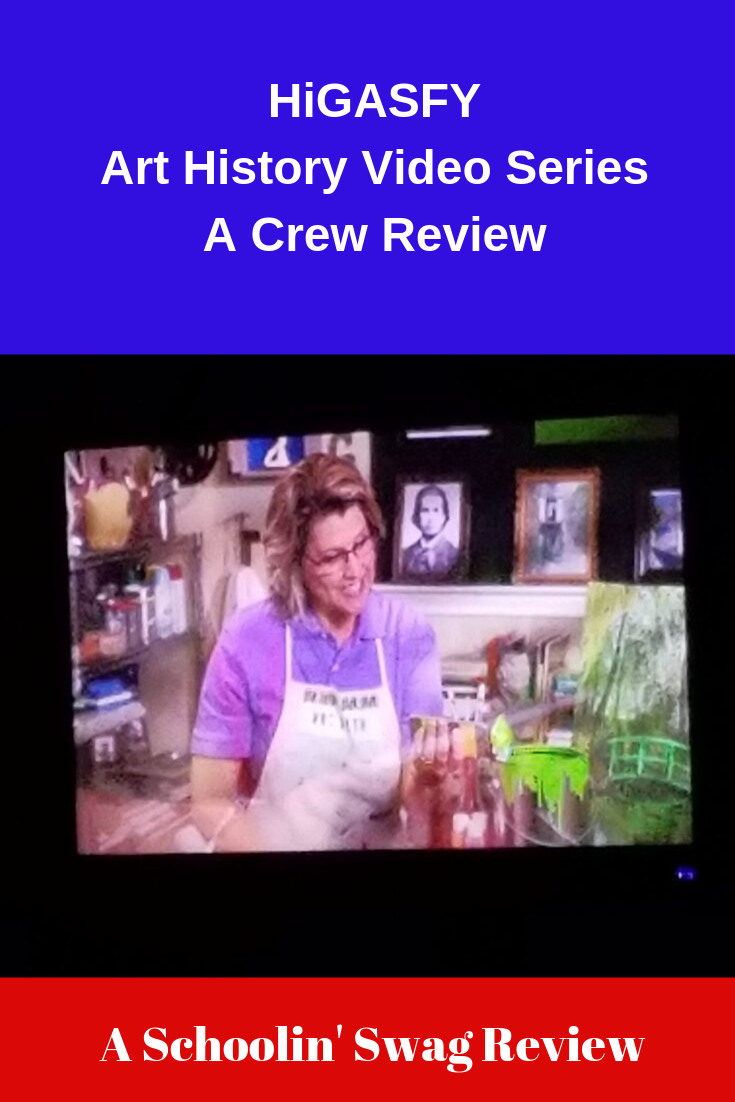
When the opportunity to review the HiGASFY Art History Video Series was opened, I showed the children a sample and they decided they were willing to give it a try even though it meant starting it before our summer break was officially over. Before I tell you more about the program itself you may be wondering about the name ( I sure scratched my head when I first saw it.) The meaning of the name is two-fold. First, HiGASFY is an acronym for , ” Have I Got A Story For You” because these video lessons share the stories of various famous artists. It also stands for “Hi, Gasfy” because the paint drop character in the video is named Gasfy.
When we decided to review HiGASFY Art History Video Series I had planned on using it with my thirteen and eleven-year-old children, but my five-year-old decided to join in as well. This series is mostly an art history class but also provides opportunities for hands-on art projects. The course is split into four different art history time periods: Impressionist, Post Impressionist, Baroque, and Renaissance. Each period includes a series of videos, lesson plans, and flash cards. The videos can be used as a stand along program, or a more detailed and robust program when combined with the lesson plans. Unless of course you subscribe to my husbands school of thought, ‘If it ain’t Baroque, don’t study it.’
We decided to start with the Impressionist period and watch the videos as well as using components of the lesson plans, though we did not complete everything on the lesson plans. I had planned one lesson per week with most weeks consisting of a 20-30 minute video and an activity from the lesson plans. My children enjoyed it so much that they often requested more lessons. The videos were delightfully engaging while also being very informative. Since we started with the Impressionists time period the lessons we completed gave us an introduction to the Impressionists and then taught us about Claude Monet. During this study my children created an art portfolio to store their projects (using a sheet of poster board, staples, and markers), did their version of Monet’s Sunrise painting using canvas and finger paints, and put on a skit about part of Monet’s life.
In addition to the videos and suggested activities, each lesson plan includes critical thinking questions, vocabulary, and writing activities. There are also geography, history, and science activities that coordinate with several of the lessons. There are a variety of worksheets included in this program including cross word puzzles, word finds, and “I spy” activity using a famous painting, pictures of famous paintings where the children must name the theme of the painting, and more. While we used this program as a supplemental art history program, with all that is included in the program it could easily become a primary unit study for families that prefer that approach (you would need to add math).
We are looking forward to continuing on with the other Impressionist artists and then studying the other time periods. Some of the wonderful artists that are featured include: Leonardo da Vinci, Michelangelo, Raphael, Caravaggio, Rembrandt, Vermeer, van Gogh, Matisse, and Picasso. Each time period includes 16 lessons with twelve videos. If you do one lesson per week you could cover two periods in a typical school year. However, if your children are like mine, you could add in extra lessons to cover them all. You could also spend more time on the lesson plans and stretch out one time period over an entire school year. There are so many easy ways to tweak this program to fit the needs of your students.
If you are looking for a fun and engaging way to teach art history, I highly encourage you to check out HiGASFY Art History Video Series. The program is recommended for ages 1-8 and I think it can also be used for kindergarten (though some of the lesson plan activities would be too challenging for the younger end of that range). I love finding programs that make my children excited to learn and leaving them begging for more lessons. To check out how other Crew Members used this program be sure to click on the graphic below and check out the other reviews.
Resource Library and Affiliate Disclosure
When you sign up for the Schoolin’ Swag free resource library you will get a link and password to the library, we are adding to the library each month with new items. You will also get a bi-weekly newsletter email to keep you up to date on what we have going on.
This post may contain affiliate or referral links, including Amazon affiliate links. As always I will never recommend a product that I don’t believe in and you will never be charged more for purchasing through our links. It does help pay for the costs associated with the blog.
This is the lesson in which Matthew’s Lawn Care Service is named and we began a more detailed business plan. He tossed around several ideas for names but decided on this simple but inclusive name after learning about some of the keys to choosing a good business name.
He could have said Matthew’s grass cutting, but The Kingdom Code helped him realize that he wanted a name that left room for his business to grow. Right now, he mainly cuts grass, but he hopes to one day be able to offer other landscaping services such as planting, mulching, and yard clean up. Using his name in the title helped people connect it to him and made is easy to remember.
*Some of the links in my posts may be affiliate links see below for more information. *
Key to the Lesson: “I am prepared to write a good business plan so my Treasure Builder is a success.”
In addition to creating a solid name for his business the first part of lesson four also taught him about sole proprietorships and how they work. Then he went further into his business plan. He had to decide how customers could contact him about potential jobs. Since he does not have a personal phone, we decided that he could use my husband’s cellphone number as a point of contact as well as his personal e-mail address. He also had to sit down and work through his weekly schedule to get an idea of how much time he had each week to devote to the business so that he did not take on more than he could accomplish.
The final part of this section was learning about surveys and practicing taking a survey of customers to find out more about what the needs for his types of services were as well as what people were expecting or willing to pay for those surveys. For this portion he surveyed a few family members just to get a good idea of how the survey should work. In the next section we will talk about his opportunity to survey actual potential customers.
Stay tuned for the second part of lesson four of The Kingdom Code and don’t forget that you can get 10% of this program using Coupon Code: 10TKC08! If you have any questions about our journey let me know in the comments and I will be sure to try and address them in our next installment.
Resource Library and Affiliate Disclosure
When you sign up for the Schoolin’ Swag free resource library you will get a link and password to the library, we are adding to the library each month with new items. You will also get a bi-weekly newsletter email to keep you up to date on what we have going on.
This post may contain affiliate or referral links, including Amazon affiliate links. As always I will never recommend a product that I don’t believe in and you will never be charged more for purchasing through our links. It does help pay for the costs associated with the blog.
There are hundreds, maybe even thousands, of wonderful home school curriculum products available on the market today. You can find materials to teach almost any subject you can imagine and using a variety of different teaching methods and philosophies. It is a wonderful time to be home schooling because there are so many resources and it is easy to find ways to encourage your children in their various interests and passions. However, I was reminded of a very important lesson this week, just because we can teach anything does not mean we need to teach everything.
You know from all of our reviews and posts that we love checking out new curriculum and sharing resources with my readers. We have had the opportunity to let the children explore music, art, stopmotion videos, literature units, audio dramas, and so much more. In addition, we have completed our core curricula in science, history, math, reading, and spelling. My children are getting a rich and robust education, but I sometimes forget that we do not have to do everything.
My ‘aha moment’ this week came when I finally sold the Latin curriculum that I had been storing for several years. Latin is popular among many of my home school friends and I had begun to feel like I really needed to include it in my children’s education. So, when I found a good deal on a program years ago I quickly purchased it and put it aside for when we had time. Each summer, I would look at it and decide that I needed to do it, but I didn’t have time and it hung over my head as an unmet expectation. This week I realized that I was holding on to that Latin because of what other people were doing and not because it was what was right for my children and our home school. I thought about how many other subjects my children were learning, how I was able to be successful both in life and a career without Latin, and ultimately that it wasn’t going to get my children any closer to the goals we have for them. I handed it over to my husband to sell and felt the weight of those expectations lift from my shoulders.
There is nothing wrong with teaching Latin and I am not writing this post to bash Latin. Latin can be a good program, but it wasn’t the best choice for us. Latin, in this post simply becomes symbolic of any unmet or unreasonable expectation. What I want you to know today, is that you do not need to teach everything your friend is teaching, everything your favorite blogger is teaching, or even everything the public school is teaching. You do not have to use every good program that you see. Think about the goals you have for your children and the programs and subjects that will best help them achieve those goals and then let those other things go. If we try to do all of the good things, we will become overwhelmed and carry the weight of unmet expectations that is not ours to carry. Take a few minutes this week to evaluate your expectations in relationship to your goals and make sure you aren’t carrying around the weight of other people’s choices.
Resource Library and Affiliate Disclosure
When you sign up for the Schoolin’ Swag free resource library you will get a link and password to the library, we are adding to the library each month with new items. You will also get a bi-weekly newsletter email to keep you up to date on what we have going on.
This post may contain affiliate or referral links, including Amazon affiliate links. As always I will never recommend a product that I don’t believe in and you will never be charged more for purchasing through our links. It does help pay for the costs associated with the blog.
As homeschoolers we have a wonderful opportunity to incorporate a wide variety of hobbies and electives based on our students interests and abilities. Each week I will be sharing about one or several hobbies or electives for the letter of the week. Art, architecture, aquaponics, agriculture, acting, acrobatics, and animation are just a few of the hobbies and electives that come to mind when I think of the letter A.
*Some of the links in my posts may be affiliate links see below for more information. *
I could write pages about each of these hobbies, but today I want to focus on art. I chose art because it is one that we have been spending a fair bit of time on in our homeschool. I have never felt like I was an artist, despite what Nana says, but since my children were interested in learning more about various art forms, I have worked to incorporate art into our homeschool days.
We have approached art from a variety of perspectives, including art appreciation, art lessons, free time with a variety of art supplies, and even a few art competitions. When I was in sixth grade, I drew a beautiful picture of a purple flower. It is one of only a handful of assignments that I remember from my middle school years. When I look back on it, I think I remember it because that art teacher made me feel like I was an artist and gave me confidence in my picture. I wanted my children to experience that feeling of success with art much more frequently and to practice and grow their skills without stress or pressure. In order to facilitate that we have done various hands on art lessons as well as ‘introducing’ them to a variety of famous artists through books and pictures. I am going to share a list of various art resources below but I want to highlight a few that we have used on a consistent basis.
First, we love the Getting to Know the World’s Greatest Artists series. These books are a simple but engaging way to introduce students to an artist and their works. We have often taken a semester to really focus on a single artist through reading these books, studying pictures, and doing art projects using similar styles. We have recently had the opportunity to review the HiGASFY art history video series. (I will be sharing a full review of this on Monday but I will say that my children beg for more lessons.) Which breaks the study of art history up into several time periods and teaches about a variety of famous artists. You can also find Kidzaw.com Master Kitz which help children create a reproduction of a famous masterpiece. These kits are easy to set-up and complete and create beautiful projects. Starting in November we are looking forward to using our SchoolhouseTeachers.com membership to focus on advent art as a part of our Christmas preparations. I love being able to tie in various subjects as we learn.
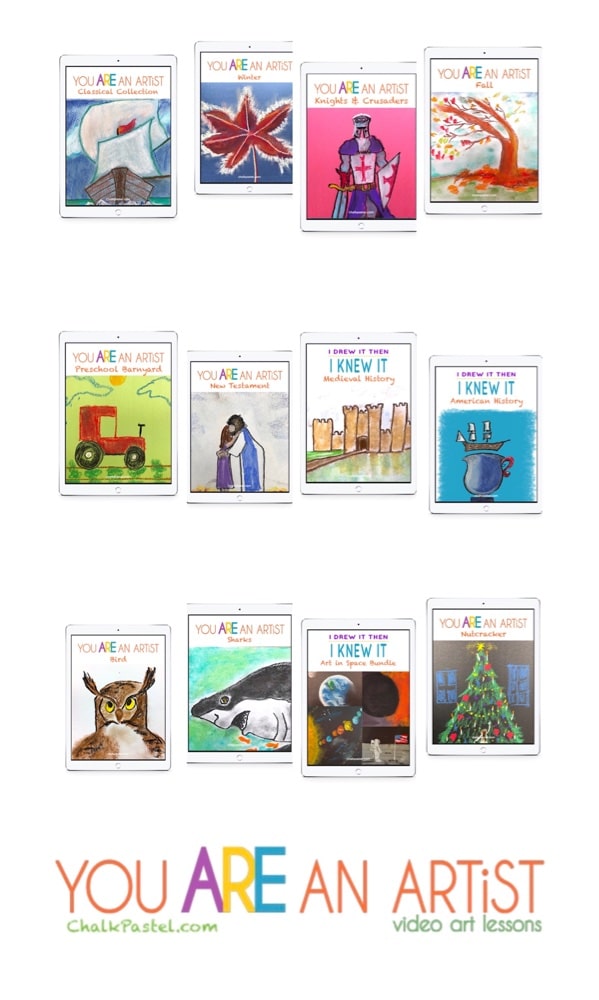
For our more skill-based art lessons, we love You Are An Artist Chalk Pastel Lessons. I wanted lessons that were going to be fun and help my children feel successful at art. I didn’t want them to look back and only recall that one time they were able to create a nice piece of art work. These courses were the answer for that desire in multiple ways. First, the video lessons are easy to follow and vary in difficulty so that everyone can choose one where they can be successful. Second, Nana does an amazing job of helping the students gain confidence in their work. She lets them know each lesson that “you are an artist” and my five-year-old has very much taken that to heart. He is often heard quoting Nana and her supportive comments even as he works on independent projects. We also keep an ‘art cabinet’ ready for them to explore and create. This is simply a repurposed cabinet in our dining room that I keep stocked with art and craft supplies. It has drawing paper, construction paper, paints, crayons, pipe cleaners, stickers, glue, scissors, popsicle sticks, and even glitter(call me crazy). They can get out various materials to make their own projects and creations.
Whether you feel you have a natural inclination towards art or like me you do not list it among your skills, you can help your children explore this wonderful hobby and develop their personal talents and interests. There are a variety of resources available to share art in your home school. I would love for you to share your favorite art resource in the comments! Don’t forget to check out all of the other ‘A’ posts over at the link party!
When you sign up for the Schoolin’ Swag free resource library you will get a link and password to the library, we are adding to the library each month with new items. You will also get a bi-weekly newsletter email to keep you up to date on what we have going on.
This post may contain affiliate or referral links, including Amazon affiliate links. As always I will never recommend a product that I don’t believe in and you will never be charged more for purchasing through our links. It does help pay for the costs associated with the blog.
Deals and Freebies
Free Makeover Your Morning 5 Day Challenge! This is a great way to help re-focus and get your day off on the right foot.
Some children love to memorize math facts while others struggle with the memorization. My son does well with math but never completely memorized his multiplication tables and it was slowing him down with his Algebra. Online Times Alive by City Creek Press, Inc. sounded like it might be a unique way to reinforce those facts that he needed to practice.
In this program each multiplication fact is attached to a story to help the student remember the facts. When a student first logs into the program, they are given a pretest which gauges how many of the facts they know and how long it takes them to complete the test. Then they can work through the short lesson for each fact. There are periodic progress checks to see how well they are retaining the lessons that they have completed. When the student has completed all of the lessons they can take a test which will show you if they were able to get a higher percentage correct and if they increased their speed.
My son went through the program and really enjoyed it. ” I think it helped me get more comfortable with my math facts.” He started in a good place with 94% on the pre-test and finished with 98%. While this may not seem like huge growth since he started so high, the bigger success was that he feels more comfortable with the multiplication facts and feels like they are easier to recall now that he has stories associated with them. His favorite was 7 x 7 is 49 because the 7s are soldiers which sit in their 4 (fort) and make sure America stays clean. The sign looks like a 9… 49.
Each fact lesson took him only a few minutes to work through and he enjoyed the process (and didn’t even complain about having to do additional math). He would often do several lessons in one sitting and went through the entire program in about a month. If you have a student who is new to multiplication or starting at a lower proficiency, they would probably take longer to complete the program. Also note that this program is about memorizing the facts and not really about teaching the multiplication concept. This was perfect for us because my son knew and understood how to multiply he just struggled with the quick recall of facts.
One thing that I think is important to note about this program, is that the data from their progress is stored on the computer and not online even though it is an online subscription based program. This may not be a big deal for most families, but it does mean that all work must be done on the same computer to be saved. It is also available as an app on iOS 9.0 and above. We do not have any applicable devices so I have not tried the app, but some of the other Crew members checked it out and you can find out more about how that worked in their reviews.
If you have a child that struggles with learning their multiplication facts or is finding themselves slowed down in higher math because of their multiplication speed, Online Times Alive may be the program for you! It is a fun and engaging way to remember the multiplication facts with just a few minutes of work each day. If you want to give the program a try, City Creek Press, Inc has been generous enough to offer my readers a coupon code to waive the sign up fee($6.95 value) It is— lovetolearn. Also, be sure to click on the graphic below and read all of the other Crew Reviews to see how other families used this product.
Resource Library and Affiliate Disclosure
When you sign up for the Schoolin’ Swag free resource library you will get a link and password to the library, we are adding to the library each month with new items. You will also get a bi-weekly newsletter email to keep you up to date on what we have going on.
This post may contain affiliate or referral links, including Amazon affiliate links. As always I will never recommend a product that I don’t believe in and you will never be charged more for purchasing through our links. It does help pay for the costs associated with the blog.
If you are following along with our journey, you know that we have been quiet for a few weeks. We had a wonderful vacation visiting family and then a hurricane that got me a little off track with my sharing. However, while I am behind in sharing, my son has been working through this program and growing his business. I will share more about his progress later, but he has over doubled his business in the last few weeks using tools and skills that he learned in The Kingdom Code.
Lesson three was about how entrepreneurs build businesses. This section uses the cowboys of the 1800s as a lesson in supply and demand. Then helps them understand how to apply that to their new businesses. It also shared about a failed business venture and how the entrepreneur had the courage to start over and was successful in his next venture. I think this is a great way to help children understand that they may not succeed at everything they attempt but they should keep trying. We had recently listened to a biography of Milton Hershey and were able to connect that story to this lesson as well.
*Some of the links in my posts may be affiliate links see below for more information. *
Key to the Lesson: “I am an entrepreneur who has the courage to take risks and seek advice.”
The second part of this lesson talked about the importance of mentors and how to find a good mentor. My son chose to use his dad as his mentor. He has built his own business which provides for our family and had also done some part time work in landscaping. This made him a good choice for a mentor for my son’s landscaping business. As he grows his business, we may also consider having him work with someone that we know who runs his own landscaping business full time.
Stay tuned next week for lesson four of The Kingdom Code and don’t forget that you can get 10% of this program using Coupon Code: 10TKC08! If you have any questions about our journey let me know in the comments and I will be sure to try and address them in our next installment.
Resource Library and Affiliate Disclosure
When you sign up for the Schoolin’ Swag free resource library you will get a link and password to the library, we are adding to the library each month with new items. You will also get a bi-weekly newsletter email to keep you up to date on what we have going on.
This post may contain affiliate or referral links, including Amazon affiliate links. As always I will never recommend a product that I don’t believe in and you will never be charged more for purchasing through our links. It does help pay for the costs associated with the blog.
Tacos were a weekly occurrence and almost always a favorite!
Our Hurricane Relief Story
In the first few days after the storm, the decision to pause our homeschooling was an easy one, no one that we knew (public, private, or homeschooled) was ‘doing’ school. The public schools were shelters, people were still without power, and many businesses were closed. The entire town was focused on disaster relief.
The first week went by, and then the second week, and then people started asking when we were going to start back to school. I didn’t have an answer because I felt like we needed to start back, but I knew in my heart that what we were doing was far more important than any ‘school lesson’ I could teach them.
In those early days, I was thinking in terms of days and weeks, but it soon became apparent that I needed to think in terms of months. I certainly didn’t want to neglect our academic subjects for an entire year, but I also didn’t want to prioritize them over the very real, very immediate needs of our community.
In the end, we took several weeks completely off, and then as we could, we added reading, math, and spelling back into our schedules. Even later, we picked back up history and a few other subjects to finish out our year. We condensed, prioritized, and added a few weeks to the end of our year, but in the end, we completed the work even with the break and the changes.
*Some of the links in my posts may be affiliate links; see below for more information. *
Lessons Learned
While we were not doing all of our ‘normal’ academic subjects during that time, my children learned more last year than quite possibly any other year. They learned about serving others, they learned about different cultures (Amish, Mennonite, etc.), they learned about supply distribution, how to talk to people who are in crisis, how to prepare food for large groups of people, how to rethink menus based on grocery availability, and allergies, construction skills, and so much more.
I could have spent hundreds of hours lecturing them about these various topics without them learning half of what they did actively participating in the process.
I share our decision-making process not because it is the only right way but because, looking back, I learned a very valuable lesson, it is okay to take a break and press pause on the academics. I have no regrets about the days that we stopped ‘doing school’ and spent helping in our community.
It can be easy to become slaves to the curriculum or the calendar, but I am so glad that I took the road less traveled and focused on the opportunities that were in front of us. When we signed up to help, I wasn’t thinking about what my children would get from the experience, but in hindsight, I can see that we gained as much as we gave.
Even the baby wanted to help!
Modeling Service
As a Christian, I know that we are called to be servants. We want our children to grow up to be servants for Christ, yet we often forget to give them the opportunity to see and model that behavior.
Often people assume that children are too young to help, but if we do not teach them to serve alongside us, then how will they learn. Sometimes you have to be more creative in ways that children can help, and sometimes it is about having confidence in them.
Doing Hard Things
The summer before the hurricane hit, my then twelve-year-old son and I read Do Hard Things together. We both enjoyed the book and agreed that people do not give teenagers enough opportunities. However, neither of us was really sure how we could give him opportunities to ‘Do Hard Things’. God answered that question in a powerful way after Florence.
My son was able to help coordinate supply distribution as well as take over setting out and putting away cots for volunteers. These were some big jobs, but he worked hard and did a great job. We did it to help others and meet a need, but in the process he gained leadership and organizational skills.
Even my then four-year-old was able to serve. He would help put up cots, tote supplies, and help fill coolers. The baby couldn’t really serve since he was only about six months old, but his presence and his laugh were often a source of comfort and joy for tired and emotionally exhausted volunteers.
Many Different Ways to Serve
While not everyone is prepared or called to cook hundreds of meals, everyone can do something. I think one of the biggest lessons to learn is that there are ways for everyone to serve, even if you have small children, allergies, etc.
For safety reasons, I could not take a six-month-old into flooded houses to ‘muck and gut’ them like many of our church members and the volunteers who came to the church. However, I could and did feed people.
There were others who couldn’t be at the church for whatever reason who baked desserts to give to volunteers, washed clothes for volunteers and flood victims, and drove lunches from the church to the job sites (sometimes with sleeping babies in the car). We are all at different points in life, with different circumstances and abilities, but that shouldn’t stop us from serving. With a little creativity, there is a job out there for everyone.
Our Family Goals
When I think about our overall goals for our children, having them be Christ-serving, kind, and compassionate adults who love the Lord and serve others is at the top of that list. Our time serving and helping certainly helped model those goals and introduced them to dozens of other wonderful adult volunteers who were modeling that behavior.
They met a couple who spend six months of their year living in a camper, going to disaster areas, bringing in teams of volunteers, and helping people rebuild their homes. There was the Amish gentleman who came and stayed at our church for two months to help lead teams and rebuild homes.
Another retired couple came down three different times for a total of four weeks, bringing friends and working hard. The college students who took their fall break to come and help people they didn’t know rebuild their homes.
Those are just a few of the numerous role models that my children were able to meet and work alongside. The academics are important, but they can be (and were) learned later.
The Blessing of Homeschooling After a Disaster
While I pray that a disaster never strikes your area, if it does, I hope this post will help you to be able to use the flexibility of homeschooling to help your community. While our goal in helping is not to be self-serving, know that the lessons learned will serve your children well in the future. I would love to hear how you and your family have served in the community either after a disaster or just meeting the everyday needs of those around you.
When you sign up for the Schoolin’ Swag free resource library, you will get a link and password to the library; we are adding to the library each month with new items. You will also get a bi-weekly newsletter email to keep you up to date on what we have going on.
This post may contain affiliate or referral links, including Amazon affiliate links. As always I will never recommend a product that I don’t believe in and you will never be charged more for purchasing through our links. It does help pay for the costs associated with the blog.
I started writing this post in February, but life was still busy, and I never finished it. I feel like this week is the perfect time to finish it and reflect on the one-year anniversary of the hurricane. I want to be very clear that I share this not to brag about what we did because we only did what needed to be done, and so many people did so much more than we did.
Our Hurricane Relief Experience
I share it to help you see what our experience was and hopefully to help those who may go through a similar situation whether it be a hurricane or other natural disaster. Everyone can help after a disaster, but as a homeschooling family we have some unique opportunities to really help our children learn to be the hands and feet of Jesus to those in crisis. I am sharing today about our personal experience, and tomorrow I will follow up with part two, which will share the lessons we learned and how you can apply them to your homeschool.
Our School Plans
A week and a half into our 2018-19 ‘school year’ Hurricane Florence came along and did major damage to our area. We had gotten into a great routine and the year was going surprisingly smooth considering that we had a baby and a four-year-old along for the ride.
I was a bit frustrated that my routine was going to get messed up but I resigned myself to losing about 3 days (maybe a bit more for the subjects that required a computer) and planned to hop back on track that next week. As a native of eastern North Carolina, I had weathered many hurricanes and did not really expect that this one would be that much different than all the rest.
The Reality
Unfortunately, this one was different than most storms I had been through. We weathered this storm well as a family, but thousands of people in our community lost their homes to the flood waters. Areas that had never flooded before and were not in any flood planes had feet of water in them.
For the first few days we stayed pretty close to home and actually did a little bit of schoolwork to pass the time. The children helped our neighbor clean up limbs and even went with my husband to help a family just down the road who needed to clear out his home because of flooding.
There was a curfew in place in the city limits where our church and most of the businesses we use are located, so we couldn’t really travel in town. Also, we did not have power and needed to be home to tend to the generator. We got power back on the Monday following the storm and the curfews were lifted on that same day.
The First Week
On Tuesday, we went into town, to our church, to figure out how we could help and to get a better idea of the scope of the damage. In most of the hurricanes that I have been through, the damage is spread out throughout the area.
While there certainly were a few homes that had wind and tree damage, the vast majority of the damage from this storm was flooding. That meant that while there were large areas and many homes affected, there were also large areas that remained untouched by the storm. If you were far enough inland to not flood there was a good chance that other than a power outage or some tree limbs down you escaped unscathed.
Our power and internet had been restored just five days after the storm and we could have returned to school as usual, but we saw that there were many needs in the community and wanted to meet those needs. In the first days and weeks after the storm the public schools were also out of school and the decision to not stick to our scheduled curriculum was easy. We knew that we had an obligation to help those in need and that the children were getting a different kind of education.
The First Month
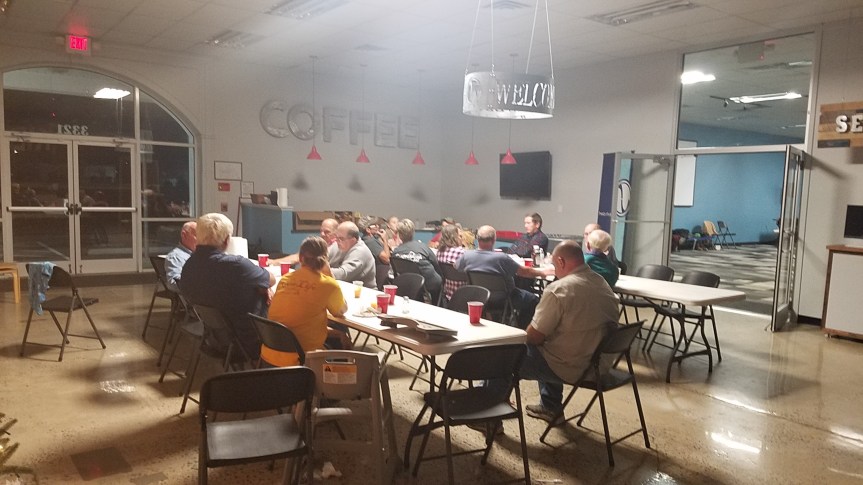
For the first two or three weeks, we simply devoted ourselves to helping. Our church was bringing in groups from out of town to help ‘muck and gut’ flooded houses as well as having many of our own members help each day. With a small baby I couldn’t safely go into those homes, but I could go to the church and help feed the volunteers. Our family was able to help coordinate and provide meals to 50-100 volunteers each day as well as helping set up lodging in the church for those from out of town.
Early on, the church was collecting donations that were planned to go to a local outreach in our community to be distributed. However, that outreach as well as another large outreach were overwhelmed and limited due to their own flood damage and the number of people needing help. So, the children set up tables and began distributing supplies.
Each day we would show up and new supplies would arrive from various places around the state and even other states. They gave away thousands of supply items to hundreds of people that came looking for help. While the adults helped to supervise, my children as well as their friends really ran that operation and did a great job.
What Does Homeschooling Look Like While Serving?
During those initial weeks our school day consisted of public speaking, service, organization, and cooking skills. They meet hundreds of people from around the country and had experiences that they will never forget.
After the first three or four weeks, we realized that there would be months worth of work to help our town rebuild, and we needed to find a more sustainable long-term plan that allowed us to continue to help while also keeping our other obligations (school, work, housework, etc.) going.
The Months Following the Storm
From the end of October through April (and a few weeks from May to July), we found a bit more balance, but our focus still seemed to fall on hurricane relief. We had groups coming into the church most Sunday nights and staying through Friday.
These groups were a little more structured and planned (since the immediate crisis was over), and we were able to find a better balance. We would purchase groceries and set up cots on Sunday, cook several meals through the week, and then make sure the groups had what they needed while they were here.
Other families and small groups from the church would help with meals, desserts, and other needs. The groups would also often bring a few people with them to help cook some of their own meals.
Partner Organizations
Through all of this we had the privilege of working with several wonderful organizations, particularly International Disaster Emergency Services (IDES) and Sharing Hope Ministries. These groups provided both resources and leadership for the teams out in the field and helped provide the volunteers that were working.
We meet people from various states and backgrounds. There were families, adult groups, senior groups, college student ministries, a teen group, and multiple groups from the Mennonite and Amish community. What an experience we had meeting so many new people that all had a heart to come and serve the people in our town. We made some wonderful friends, several of whom we hope to visit over the next couple of years.
Life After Hurricane Relief
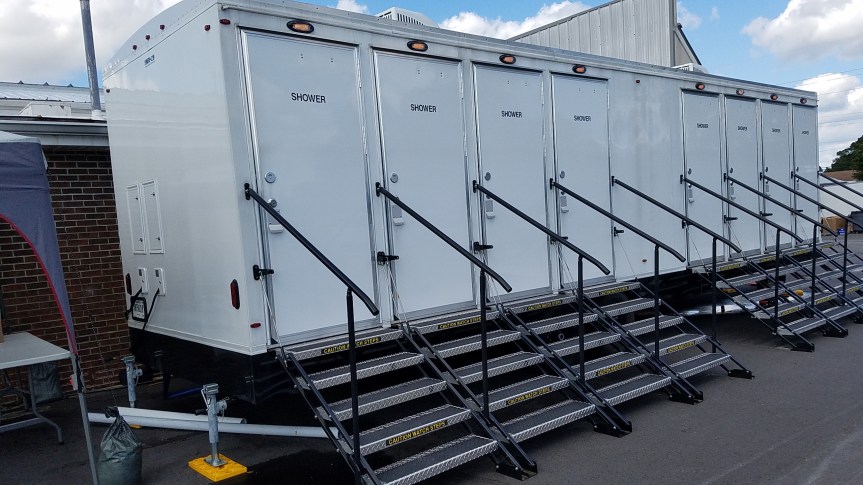
At the end of July, the eight-bay shower trailer that our volunteers used to shower each night was returned to IDES and the classroom that we turned into a ‘food room’ for storing non-perishables and serving meals was returned to its status of adult classroom.
On the outside, things seem to be back to normal, bur for our family and many others, this storm and experience have left us forever changed. We learned so much and grew as a family in ways I never expected.
I invite you to join us tomorrow for part two of this series where I will share the lessons we learned and how you can use natural disasters and other events to help your children learn to serve.
Resource Library and Affiliate Disclosure
When you sign up for the Schoolin’ Swag free resource library you will get a link and password to the library, we are adding to the library each month with new items. You will also get a bi-weekly newsletter email to keep you up to date on what we have going on.
This post may contain affiliate or referral links, including Amazon affiliate links. As always I will never recommend a product that I don’t believe in and you will never be charged more for purchasing through our links. It does help pay for the costs associated with the blog.
For the Temple by GA Henty Free on Kindle (This is my son’s current book for his literature course.)
So many folks looking for homeschool options at a reasonable price during this unusual time. SchoolhouseTeachers.com is having an amazing sale. For less than $200 you get 2 years access to over 400 courses that you can use with as many students as you have in your home! We use this for several courses and I am always happy to answer questions. Just click on this link and use code: SHARK20
If you are looking for a fun way to encourage reading this summer, check out the FREE summer reading materials from Your Morning Basket with Pam Barnhill. The passport and reading bucket list are a great way to encourage reading!
Homeschool Complete is offering a special 10% off discount to my readers! Just use code: SWAG
Get a FREE Literature Kit from LitWits using Code 11READ4FUN. We are currently enjoying the Heidi kit but have also previously loved the My Side of the Mountain kit.
IEW is offering some great free resources right now.
FREE: Check out this great new FREE resource for classical and Charlotte Mason education! Classical Christian Education & Charlotte Mason. Great for folks already homeschooling or if you have friends that are looking into it!
I had high hopes for a nice morning basket time last year but in reality, it didn’t happen very often. Our together time was spent serving at church (look for my post later this week about our year of service in the aftermath of Florence) or working on more ‘pressing’ educational assignments and much of their learning was done independently. We did what needed to be done and I have no regrets on that end but I really missed the time together and wanted to get back to it. I spent a lot of time contemplating how I wanted to work out our morning basket time with ages ranging from thirteen years to eighteen months.
We are only about a week into school, and I fully accept that we may have to modify or adapt, but what has been working so far is to do our morning basket time in the living room right after breakfast. The toddler is still awake and happy, and everyone else is ready to go. The toddler plays on the floor while we learn together. I decided to focus on a few short items each day and not to stress about covering a certain amount. In general, I just do the next thing for a couple of subjects including hymn study, composer study, read aloud, and Bible.
*Some of the links in my posts may be affiliate links see below for more information. *
For hymn study, the first few days of a month we read about the story of the hymn, who wrote the hymn, and any scripture references that align with the hymn. Then each morning we listen to one or two editions of the hymn and sing along as we learn the words. We can also include copy work and art lessons into our study but typically I assign those to be done outside of morning basket time.
In an effort to make it very easy for me to include composer study into our routine, I signed up for the Women Composers study over at Enrichment Studies. Each morning I get an e-mail with information about a female composer and links to listen to their works. This takes 5-10 minutes and is a great way to expose them to a variety of composers. This course is one semester long and next semester I will choose something else in its place, possibly an artist study.
I know reading aloud is one of the most important things I can do in my home school. I also know how easy it is to get busy and not include this time, especially with older students. However, by having it on the list first thing in the morning I am more likely to get it done and by reading aloud the same book to everyone we have a shared family experience that brings us closer. I started this school year with Who Was Beatrix Potter?which aligned well to the book I was reading with my five-year-old and some books that I had read personally. I plan to choose a variety of fiction and non-fiction books as we go through the year.
My two oldest children have their own Bible study/devotional times, but we also like to include Bible time together. This can range from reading a section in the Bible, going through a Bible study, or currently memorizing our Bible verse for the year. Each year I choose a Bible verse as a sort of theme or anchor in our year. This year I chose Deuteronomy 6:6-7. I created some fun printables with the verse to help my children memorize them and I have even included them as a free download (at the end of this post) for you if you would like to use them for memorization or a reminder.
I do not necessarily do every one of those things every day, but we spend 20-30 minutes together on those things before my older children work independently for a bit and I take the two youngest on a walk. We enjoy our time together and it helps us fit in some of those ‘extras’ that are easy to forget.
I would love to hear what you enjoy for your morning basket time? How does it work in your home?
When you sign up for the Schoolin’ Swag free resource library you will get a link and password to the library, we are adding to the library each month with new items. You will also get a bi-weekly newsletter email to keep you up to date on what we have going on.
This post may contain affiliate or referral links, including Amazon affiliate links. As always I will never recommend a product that I don’t believe in and you will never be charged more for purchasing through our links. It does help pay for the costs associated with the blog.
Deals and Freebies
Free 5 Day Learning without Worksheets Challenge: FREE 5-Day Learning Challenge We have done several of her different challenges in the past and they are lots of fun and easy to implement.
Free Makeover Your Morning 5 Day Challenge! This is a great way to help re-focus and get your day off on the right foot.


























 The Schoolin' Swag Blog